



The following is a guest post and opinion from Vincent Maliepaard, VP of Marketing at Sentora.
Tokenized funds have stopped being a novelty. Tokenized US Treasury funds alone now hold roughly $16 billion in distributed value and the list of issuers includes most of the largest names in traditional asset management. Issuance is a solved problem. The harder question is what happens to one of these assets after it exists onchain, because most of them currently do very little.
The typical tokenized fund is held, occasionally transferred, and eventually redeemed. That is a real improvement in distribution and settlement, but it leaves the asset economically idle. The larger opportunity lies in financial utility: using a traditional asset inside an onchain system as collateral, as margin, or as a component of a structured position. The two outcomes look almost identical on a balance sheet, and they behave very differently in practice.
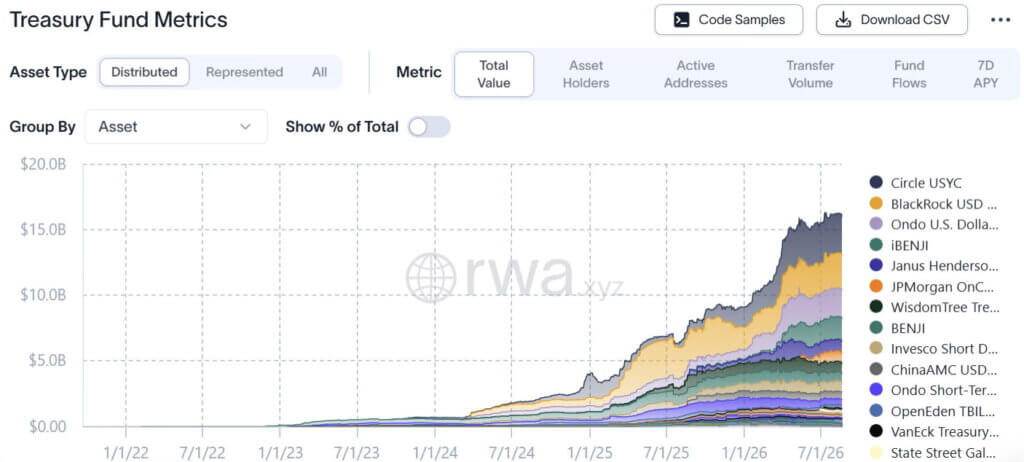
From Representation to Utility
Consider an investor holding a tokenized fund that owns $100 million of bonds. If that investor needs cash, the conventional path is to redeem the fund, wait for the underlying assets to settle, receive the proceeds, and then deploy that capital somewhere else. The plumbing is faster than it would be offchain, but the economics are unchanged. The investor gave up the position in order to access liquidity.

The alternative is to deposit the same token into a lending market as collateral and borrow stablecoins against it. The credit exposure and its yield stay with the investor, the loan provides the cash, and nothing is sold. The function of the asset changes rather than the asset itself, and that shift is where tokenization begins to look like financial infrastructure rather than a faster distribution channel.
In traditional markets, an enormous amount of financial machinery exists to mobilize the value sitting inside assets rather than simply to own them, and that machinery is what tokenization has the potential to make programmable.
Why Collateral Is a Higher Standard Than Issuance
The difficulty is that a lending protocol cannot treat every tokenized asset as interchangeable. When ETH falls through a liquidation threshold, the protocol sells it into a market that runs continuously and whose depth is visible onchain. A tokenized credit portfolio behaves nothing like that. Its underlying bonds trade during traditional market hours, its NAV may be struck periodically rather than continuously, and redemption can take days. DeFi liquidates in minutes while traditional credit settles in days, and wrapping the asset in a token does not close that gap. Closing it requires design work around the token rather than inside it.
The practical result is that an asset built for distribution and an asset built for collateral use should be held to quite different standards.
Distribution vs. collateral requirements
RequirementTokenized for distributionTokenized for collateralPricingPeriodic NAV is sufficientFrequent, reliable, oracle-ready valuationRedemptionDays to quarters, often cappedT+1 or faster, at meaningful sizeLiquidityPrimary market onlyPrimary plus committed secondary and OTC depthLegal structureClear ownershipClear ownership plus enforceable transfer during a forced unwindRisk parametersNot applicableLoan-to-value limits, borrow caps, oracle assumptions, a defined liquidation path
For an issuer, this reframes the question entirely. It is no longer whether an asset can be tokenized, but whether an onchain financial system can safely do anything with it once it has been.
mWIN as a Working Example
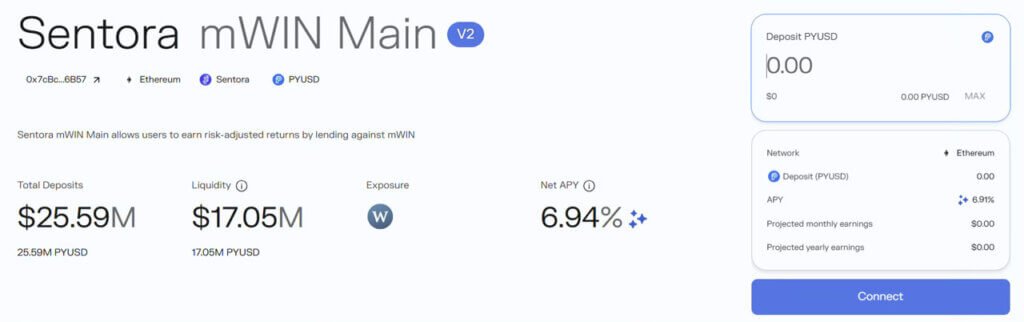
mWIN, launched in August 2026, is a useful case study because it was built against the second question from the start. Midas issues the token, Wellington Management runs the underlying credit strategy, and Northern Trust holds the assets. The strategy was issued natively onchain rather than wrapped around an existing fund after the fact, and the portfolio spans investment-grade CLOs and other asset-backed credit at a current yield of around 6.9%.
mWIN can be minted and redeemed daily on a T+1 basis, drawing on several competing sources of liquidity rather than relying on secondary market depth. Sentora then curates a Morpho market where mWIN backs loans in PayPal’s PYUSD, and sets the parameters for it based on an extensive dossier of historical NAV, past market stress events, liquidity and redemption mechanics. This combination ensures that a sensible loan-to-value limit can be set, sized so that a forced sale can complete before the collateral is worth less than the debt.
So while the token makes the asset programmable, these arrangements around it are what make the programmability safe to use.
The Path Forward: Measuring Utility Instead of Issuance
The industry currently measures tokenization by the value of assets issued onchain. That figure is easy to publish and incomplete as a signal, because it counts assets that sit idle alongside assets doing real work. A more useful set of questions is already available: how much tokenized collateral is securing loans, how much stablecoin liquidity can be raised against tokenized securities, how much collateral can move between venues without selling the underlying asset, and how much of that activity settles without leaving the common infrastructure.
The market is starting to move in that direction. Figure PRIME’s growth on Morpho this year surpassed 200 million. Aave launched Horizon in August 2025 specifically to let institutions borrow stablecoins against tokenized assets, and it currently has a TVL of over $250 million.
More and more Morpho markets are being built around tokenized credit, and tokenized equities are entering the same infrastructure.
Digitizing documents did not make the internet transformative on its own; networked documents did. Financial assets appear to be following a comparable path, moving from representation to distribution and now to utility. The eventual value of tokenization will be measured by what markets can build once these assets are genuinely usable, rather than by how many of them exist.