


In November 2022, FTX shut its doors overnight. One day it was one of the biggest crypto exchanges in the world. The next day, millions of people could not touch their own money. That single event changed how the whole world looks at crypto exchanges.
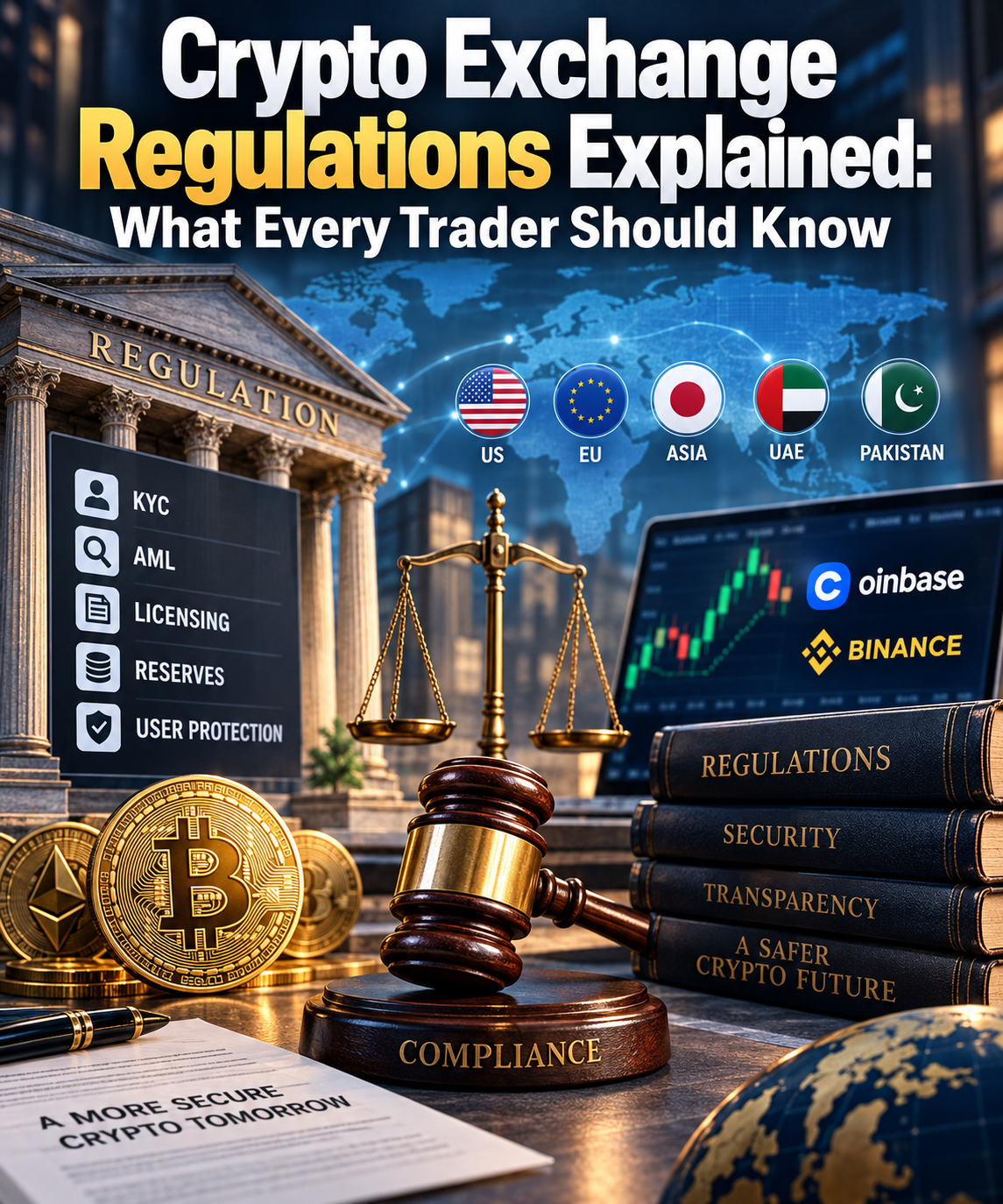
Crypto exchange regulations explained in plain words means the rules that decide how a platform checks its users, keeps their money safe, and answers to the government. If you trade crypto today, these rules are the reason some platforms feel safe and others do not. This article walks through what these rules actually ask exchanges to do, how they change from country to country, and why any of this should matter to you.
What are Crypto Exchange Regulations Explained
Crypto exchange regulations are the rules a platform has to follow to run legally in a country. They cover how you get verified, how your money is kept safe, and what the exchange has to report to the government.
Governments did not create these rules for fun. In the early days of crypto, scams and stolen funds were common, so regulators stepped in to give normal users some kind of protection.
A regulated exchange signs up with a financial authority, follows reporting rules, and keeps user money separate from its own business money. An unregulated exchange skips all of that, which means faster sign-up but far less protection if something goes wrong.

Why Do Crypto Exchanges Need Regulation
The point of regulation is to protect the people using these platforms, not to make trading harder for no reason. A few reasons stand out:
- Investor protection: An exchange that keeps your deposits is, in essence, operating like a bank, thus legislation asks it to show it can do that job.
- Fighting money laundering: Criminals moving dirty money like the quick, easy, and borderless movement of cryptocurrency, so regulators want exchanges to look out for suspicious behavior.
- Market stability: A collapse of one large exchange might trigger a panic sell-off and take the entire market down with it.
- Tax compliance: Governments want transparency into crypto gains and for this many exchanges have to hand over transaction data.
Key Regulatory Requirements for Crypto Exchanges
Most countries build their rules around the same few basics, even though the details differ.
KYC (Know Your Customer)
KYC in Crypto is the process an exchange uses to confirm you are really you before letting you trade. This usually means sending a few basic documents:
- A government-issued ID to confirm your identity
- A selfie for facial verification
- Proof of address in some cases, such as a utility bill or bank statement
Exchanges do this because regulators need a way to trace who is moving money through the platform. Without this check, anyone could open ten fake accounts to hide illegal activity, and it’s also why withdrawal limits usually rise once you finish full verification.
AML (Anti-Money Laundering) Compliance
The AML standards, which require an exchange to detect and report odd money behavior. It’s about watching transactions, alerting accounts that suddenly shift big money, and making reports when something seems suspicious. This can mean your withdrawal is put on hold for a day while the exchange checks your account in real time.
Licensing Requirements
To operate legally, most exchanges need the right license. In the US, that often means registering as a money services business and getting licenses in individual states. In the EU, exchanges need approval as a Virtual Asset Service Provider, known as a VASP.
A license forces an exchange to meet a minimum standard for security and reporting before it can take on customers, and it gives regulators the power to fine or shut down a platform that breaks the rules.
Capital & Reserve Requirements
After FTX showed how easily customer money can vanish, “proof of reserves” became one of the biggest topics in crypto. This means an exchange has to prove, often through an outside audit, that it really holds the funds it claims to hold for its users. Some regulators are also pushing exchanges to keep their own capital on hand, similar to banks, so they can absorb losses without touching customer deposits.
Crypto Exchange Regulations by Region
Crypto rules are not the same everywhere. Where you trade actually changes how protected you are.
United States
In the US, more than one agency shares the job. The SEC treats many crypto assets as securities, while the CFTC watches over crypto derivatives and some spot markets. Exchanges also need money transmitter licenses in individual states, and rules vary widely from state to state.
European Union
The EU built one set of rules for the whole bloc, called MiCA, short for Markets in
Crypto-Assets. Instead of dealing with 27 different countries separately, an exchange can get approved once and operate across the whole EU, which gives it a much clearer path than the patchwork system in the US.
Asia (Singapore, Japan, UAE)
Asia shows the biggest range of approaches. Japan runs one of the strictest systems in the world, requiring exchanges to register with the Financial Services Agency and keep customer funds in separate cold storage.
Singapore takes a calmer route through its Monetary Authority, licensing exchanges under the Payment Services Act while still keeping firm AML checks. The UAE has gone the other way, building crypto-friendly zones like ADGM and setting up its own regulator, VARA, in Dubai, with a clear licensing path that still requires KYC and AML.
Pakistan / South Asia
Pakistan has no formal license system for crypto exchanges right now. The State Bank of Pakistan has warned people more than once about the risks of trading on unregulated platforms, and banks are generally not allowed to help with crypto transactions directly. That leaves most Pakistani traders using international exchanges, without the kind of local protection you would get in the EU or Japan.
How Regulations Affect Crypto Exchanges Like Coinbase and Binance
Regulation shows up clearly in how the big exchanges run their business. Coinbase, for one, holds several state licenses in the US and is a public company, so it goes through regular audits and has to disclose a lot about how it operates.
Binance has handled things differently in different countries, changing products in some places and leaving others entirely rather than deal with local licensing rules. That is also why certain trading features are not available to users everywhere. Compliance costs decide which markets exchanges bother entering.
Challenges in Regulating Crypto Exchanges
Regulating crypto is not as simple as regulating a bank. A few problems keep coming up:
- Decentralization: A lot of crypto activity happens without a single company you can hold responsible.
- Cross-border trading: A trader in one country can use an exchange based in another, following rules set by a third.
- Balancing control and innovation: Rules that are too strict push traders toward less regulated platforms, while rules that are too soft leave people exposed to the same risks regulation was meant to fix.
The Future of Crypto Exchange Regulations
Crypto exchange regulations are moving in a fairly clear direction over the next few years:
- Global alignment: The EU’s MiCA rules are already shaping how other regions think about licensing, and more countries are expected to follow a similar path.
- Central bank digital currencies: Governments building their own digital money isn’t happening in isolation. It’s going to bleed into how exchanges get treated too, whether that’s the plan or not.
- Proof-of-reserves as standard: This used to be optional, more of a nice-to-have after a scandal. Not anymore. Expect it on every major exchange going forward, no exceptions.
- Stablecoin oversight: Regulators are paying closer attention to how each Stablecoin is actually backed, and this is likely to tighten further.
Frequently Asked Questions
What is the main purpose of crypto exchange regulation?
To protect users and to prevent financial crime. Exchanges need to know who you are to protect customer funds and to report suspicious activity.
Are all crypto exchanges regulated?
No. Some hold licenses in several places, while others run with almost no oversight, so check an exchange’s license status before depositing funds.
Which country has the strictest crypto regulations?
Japan is usually seen as the strictest, requiring cold storage and FSA registration. The EU’s MiCA rules are also becoming one of the toughest, most complete standards around.
What happens if a crypto exchange is unregulated?
It has no legal duty to protect your funds or undergo audits. If it fails or turns out to be a scam, you have very little legal way to get your money back.
How do regulations affect crypto prices?
Regulatory news can move prices fast. Good news, like MiCA rolling out, tends to support prices, while sudden bans can trigger sharp drops.
Conclusion
Crypto exchange regulations exist to protect users, stop financial crime, and keep the market steady enough to work. KYC, AML checks, licensing, and reserve rules form the base of almost every system, even though the details shift a lot between the US, the EU, Asia, and everywhere else. Knowing these rules helps you pick exchanges that actually take user protection seriously.