



Bitcoin’s mining difficulty jumped 5.54% on Oct. 29 as recovering network computing power intensified competition among miners already facing shrinking revenues.
Data from Nodewitness shows the adjustment increased difficulty from 140.58 trillion to 148.36 trillion, following another 5.92% increase on Oct. 16.
The increase comes as Bitcoin miners rebuild the network’s computing power despite an industrywide shift toward artificial intelligence infrastructure. However, the recovery is adding financial pressure, with mining revenue falling toward $33 per petahash per second daily, its lowest level since August.
Bitcoin miners rebuild network strength despite AI infrastructure shift
According to Real Vision chief crypto analyst Jamie Coutts, Bitcoin’s mining network has staged a substantial recovery following one of its steepest contractions in years.

Coutts noted that the network’s 14-day average hashrate declined 23% between its October 2025 peak and February 2026, marking the steepest decline since China’s mining ban in 2021.
The contraction reflected several factors, including severe winter weather that temporarily disrupted operations and growing concerns that mining companies were abandoning Bitcoin production for more lucrative AI infrastructure opportunities.
Although the network initially recovered, its computing power weakened again through July, reinforcing concerns about the industry’s long-term commitment to Bitcoin mining.
However, Coutts said that trend has reversed significantly since July 17.
According to his analysis, Bitcoin’s hashrate has climbed 21% over the subsequent 102 days, adding approximately 185 exahashes per second (EH/s) and recovering to within 6% of its previous record.
He described the increase as the largest absolute amount of computing power added during a comparable hashrate recovery since 2018, although the percentage gain was less exceptional historically.
Data from Look Into Bitcoin also shows the network’s computing power has reached its highest level in seven months, illustrating the scale of the recovery despite the industry’s growing interest in AI infrastructure.
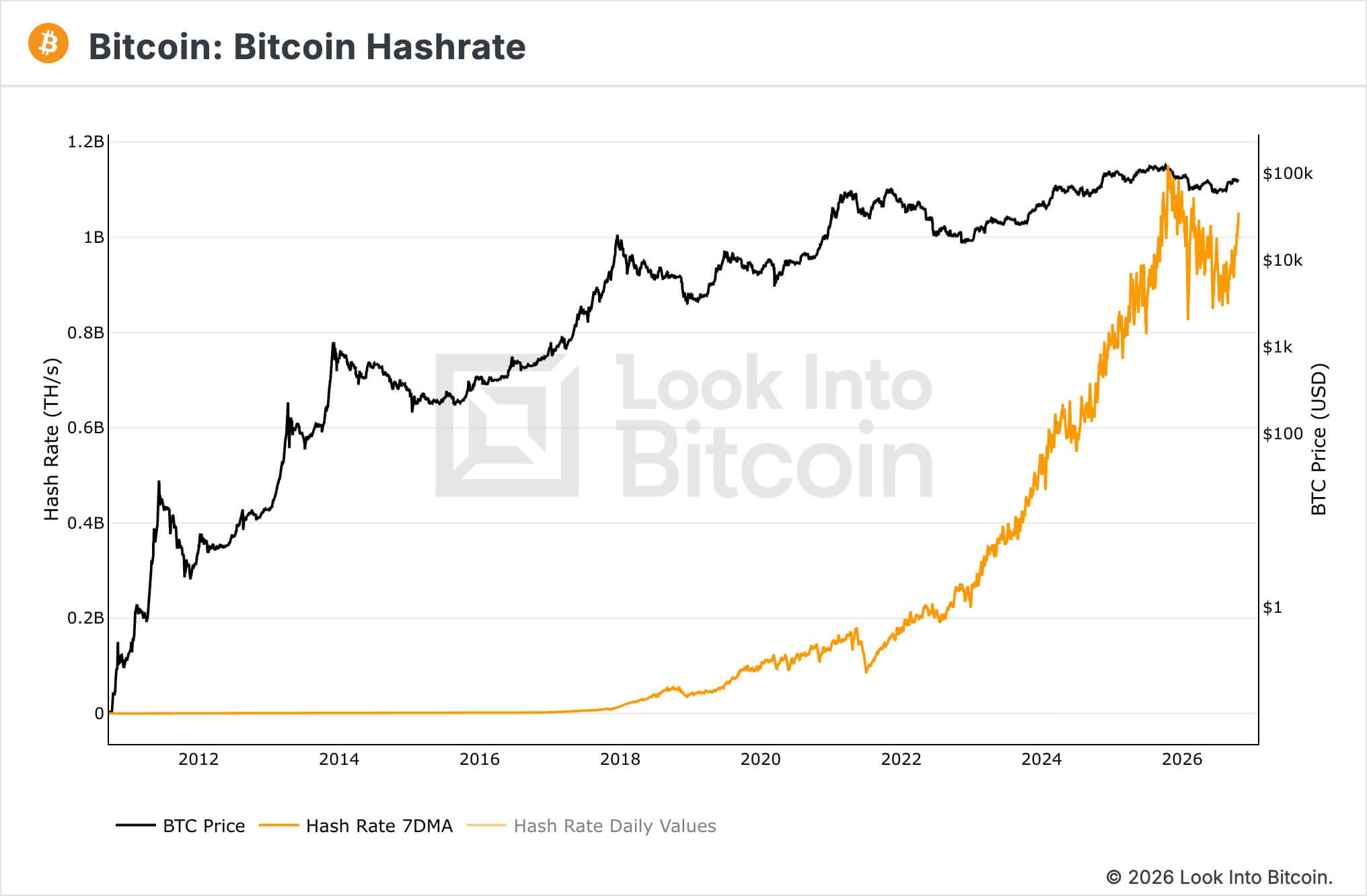
The rebound is noteworthy because several publicly traded mining companies have increasingly shifted their business models toward high-performance computing and AI data centers, where long-term infrastructure contracts can provide more predictable revenue than Bitcoin mining.
Still, Bitcoin’s network-wide recovery suggests that mining capacity is expanding elsewhere, potentially offsetting equipment being redirected or retired by companies pursuing AI opportunities.
The return of computing power also helps explain the latest difficulty increases.
Bitcoin automatically adjusts mining difficulty every 2,016 blocks, roughly two weeks, to maintain an average block production time of 10 minutes. When additional computing power causes miners to find blocks faster than expected, the network raises difficulty to restore that target.

For Coutts, the recovery signals strengthening network security and continued confidence among operators willing to deploy computing resources despite difficult market conditions.
He noted that additional computing power raises the cost of attacking the Bitcoin network, while miners’ willingness to expand on thin margins suggests continued investment in its long-term prospects.
However, that growing competition carries a financial cost for the same companies securing the network.
Bitcoin mining revenue falls toward August lows
Bitcoin’s rising difficulty means individual miners must expend more computational work to earn the same expected amount of BTC, putting additional pressure on operators already struggling with electricity and infrastructure expenses.
The latest 5.54% adjustment alone reduces expected Bitcoin earnings per unit of unchanged computing power by approximately 5.24%, assuming transaction fees and other conditions remain constant.
Across the two October adjustments, the reduction reaches approximately 10.5%.
That pressure is reflected in Bitcoin’s hashprice, which measures expected daily mining revenue for each petahash per second of computing power.
Data from Startmining shows the metric has dropped to approximately $33 per PH/s per day, its weakest level since August. For comparison, Bitcoin’s hashprice averaged $40 in September, when the network’s difficulty was considerably lower.
This means miners are earning substantially less revenue from the same computing capacity, even before accounting for electricity, maintenance, hosting and financing costs.
The impact is particularly severe for operators using older, less efficient mining equipment.
For example, at a gross hashprice of $33.35, equipment operating at 25 joules per terahash would generate approximately $32.68 daily per PH/s after an assumed 2% mining pool fee.
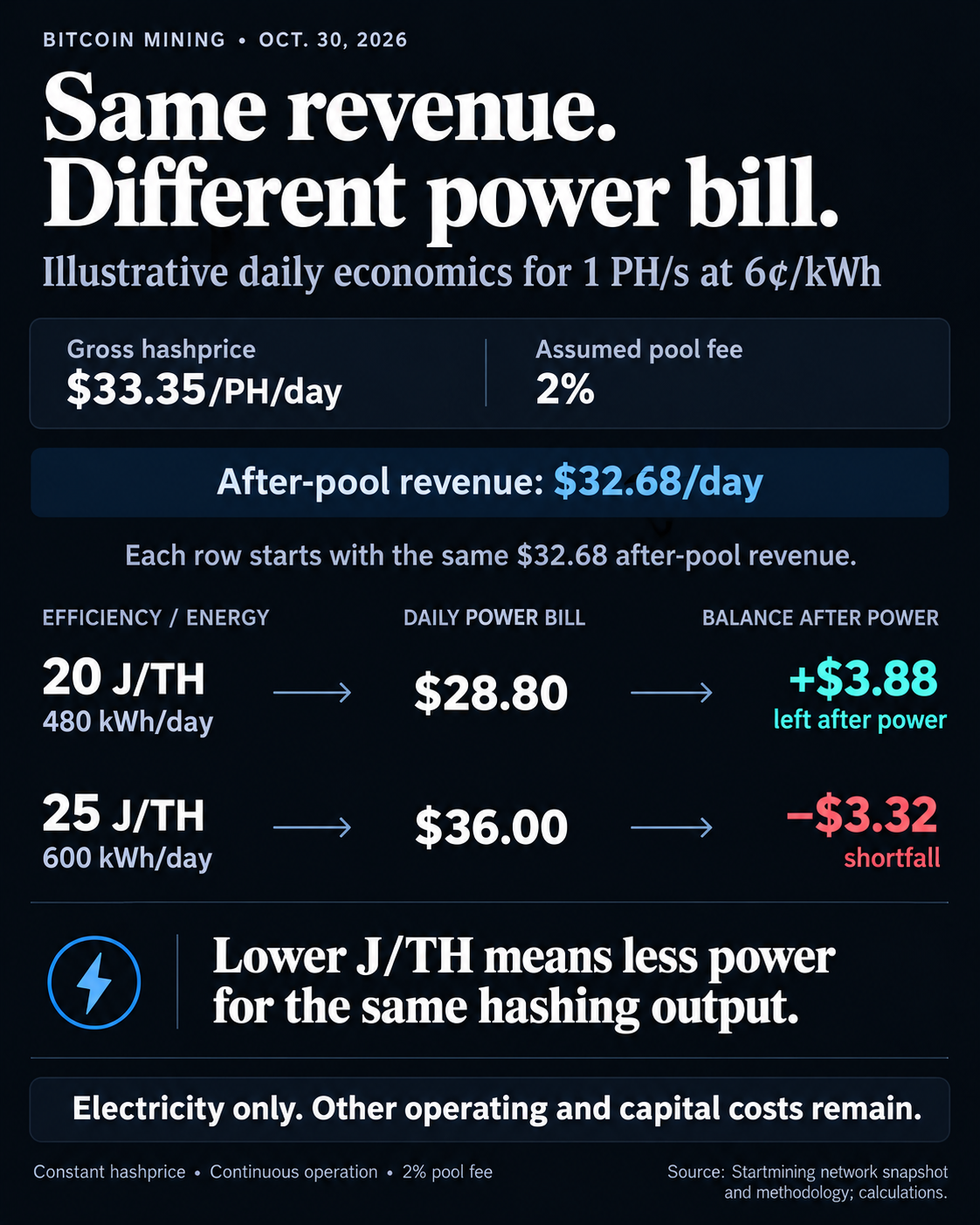
At an electricity tariff of 6 cents per kilowatt-hour, however, the same equipment would incur a daily power bill of $36, producing a $3.32 shortfall before other operating expenses.
More efficient equipment rated at 20 J/TH would spend $28.80 on electricity under identical conditions, leaving a modest surplus before additional costs.
This illustrates how the network’s recovery is widening the financial divide between miners with access to cheap electricity and efficient machines and those operating older equipment at higher costs.
For miners operating at 25 J/TH, the current hashprice means electricity must cost approximately 5.45 cents per kilowatt-hour or less just to cover the power consumed by their machines.
The economics create a growing challenge for miners seeking to expand their computing capacity.
Additional mining equipment strengthens Bitcoin’s network, but it also raises competition for the available block rewards, putting further pressure on the revenue that supports those investments.



