

Close Menu
    Facebook X (Twitter) Instagram
    Facebook Instagram YouTube
    Crypto Go Lore News
    Subscribe
    Wednesday, November 25
    • Home
    • Market Analysis
    • Latest
      • Bitcoin News
      • Ethereum News
      • Altcoin News
      • Blockchain News
      • NFT News
      • Market Analysis
      • Mining News
      • Technology
      • Videos
    • Trending Cryptos
    • AI News
    • Market Cap List
    • Mining
    • Trading
    • Contact
    Crypto Go Lore News
    Home»AI News»Researchers at MIT Propose ‘MAIA’: An Artificial Intelligence System that Uses Neural Network Models to Automate Neural Model Understanding Tasks
    AI News

    Researchers at MIT Propose ‘MAIA’: An Artificial Intelligence System that Uses Neural Network Models to Automate Neural Model Understanding Tasks

    CryptoExpertBy CryptoExpertApril 25, 2024No Comments3 Mins Read
    Share Facebook Twitter Pinterest Copy Link LinkedIn Tumblr Email VKontakte Telegram
    Researchers at MIT Propose ‘MAIA’: An Artificial Intelligence System that Uses Neural Network Models to Automate Neural Model Understanding Tasks
    Share
    Facebook Twitter Pinterest Email Copy Link
    Changelly

    [ad_1]

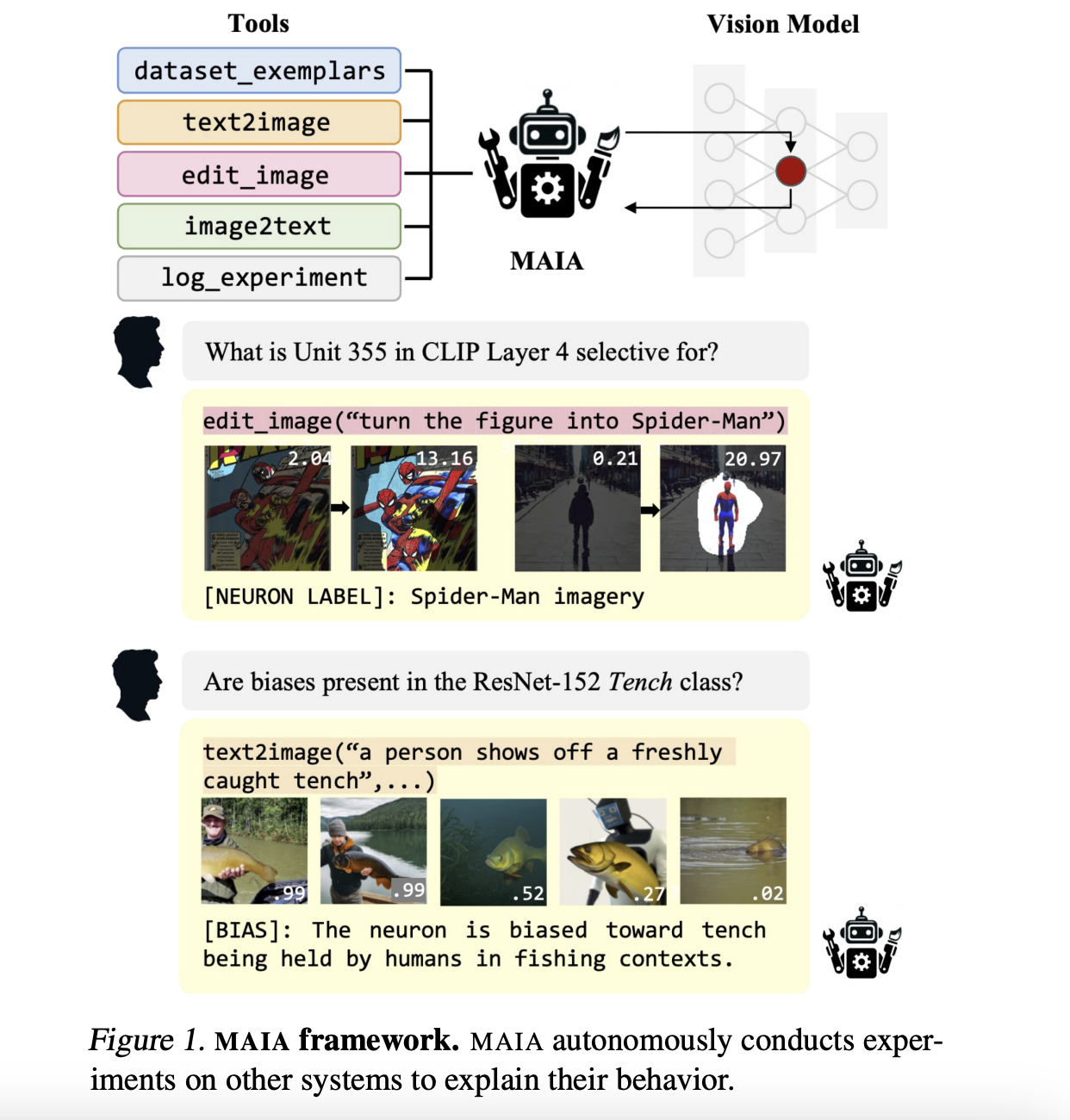
    MIT CSAIL researchers introduced MAIA (Multimodal Automated Interpretability Agent) to address the challenge of understanding neural models, especially in computer vision, where interpreting the behavior of complex models is essential for improving accuracy and robustness and identifying biases. Current methods rely on manual effort, like exploratory data analysis, hypothesis formulation, and controlled experimentation, making the process slow and expensive. MAIA (Multimodal Automated Interpretability Agent) uses neural models to automate interpretability tasks, such as feature interpretation and failure mode discovery.

    Existing approaches to model interpretability are often unscalable and inaccurate, limiting their utility to hypothesis generation rather than providing actionable insights. MAIA, on the other hand, automates interpretability tasks through a modular framework. It utilizes a pre-trained vision-language model as its backbone and provides a set of tools that enable the system to conduct experiments on neural models iteratively. These tools include synthesizing and editing inputs, computing exemplars from real-world datasets, and summarizing experimental results. 

    MAIA’s ability to generate descriptions of neural model behavior is compared to both baseline methods and human expert labels, demonstrating its effectiveness in understanding model behavior.

    MAIA’s framework is designed to freely conduct experiments on neural systems by composing interpretability tasks into Python programs. Leveraging a pre-trained multimodal model, MAIA can process images directly and design experiments to answer user queries about model behavior. The System class within MAIA’s API instruments the system to be interpreted, making subcomponents individually callable for experimentation. Meanwhile, the Tools class comprises a suite of functions enabling MAIA to write modular programs that test hypotheses about system behavior. 

    bybit

    The evaluation of MAIA on the black-box neuron description task demonstrates its ability to produce predictive explanations of vision system components, identify spurious features, and automatically detect biases in classifiers. It is effective in generating descriptions of both real and synthetic neurons, outperforms baseline methods, and approaches human expert labels.

    In conclusion, MAIA presents a promising solution to the challenge of understanding neural models by automating interpretability tasks. MAIA streamlines the process of understanding model behavior by combining a pre-trained vision-language model with a set of interpretability tools. While human supervision is still necessary to avoid common pitfalls and maximize effectiveness, MAIA’s framework demonstrates high potential utility in the interpretability workflow, offering a flexible and adaptable approach to understanding complex neural systems. Overall, MAIA significantly helps in bridging the gap between human interpretability and automated techniques in model understanding and analysis.

    Check out the Paper and Project. All credit for this research goes to the researchers of this project. Also, don’t forget to follow us on Twitter. Join our Telegram Channel, Discord Channel, and LinkedIn Group.

    If you like our work, you will love our newsletter..

    Don’t Forget to join our 40k+ ML SubReddit

    Pragati Jhunjhunwala is a consulting intern at MarktechPost. She is currently pursuing her B.Tech from the Indian Institute of Technology(IIT), Kharagpur. She is a tech enthusiast and has a keen interest in the scope of software and data science applications. She is always reading about the developments in different field of AI and ML.

    🐝 Join the Fastest Growing AI Research Newsletter Read by Researchers from Google + NVIDIA + Meta + Stanford + MIT + Microsoft and many others…

    [ad_2]

    Source link

    Tokenmetrics
    Share. Facebook Twitter Pinterest LinkedIn Tumblr Email Telegram Copy Link
    CryptoExpert
    • Website

    Related Posts

    AI News

    Muse AI Complete Beginners Guide 2026

    November 9, 2026
    AI News

    Iran releases ‘Coming Soon’ Nuclear Test Warning AI Video #breakingnews #news #steveram #iran #fyp

    November 6, 2026
    AI News

    Ai for daily ebooks template guide create launch market sell with your smart phone #ebookpromotion

    October 31, 2026
    AI News

    Telangana IT Minister’s AI Avatar Unveiled at Hyderabad DevFest 2026 | V6 News

    October 25, 2026
    AI News

    Can Generative AI help doctors guide lung biopsies with greater precision? #biomedicalengineering

    October 22, 2026
    AI News

    3 Ways to Use AI to Make Extra Money 💰 (Beginners Start Here!) #shortsviral #bizforgeamerica #usa

    October 14, 2026
    Add A Comment
    Leave A Reply Cancel Reply

    Recommended
    Editors Picks

    Goldman Sachs Boosts Ether ETF Holdings to $1.22B in Q3

    November 18, 2026

    GitHub Introduces Agent Host Protocol for Cross-Device Session Continuity

    November 18, 2026

    Elon Musk’s Grok AI Predicts a Seven-Figure BTC Explosion

    November 18, 2026

    Bitcoin Miners’ AI Pivot Hurdles Exacerbated by Nvidia Troubles

    November 18, 2026
    Latest Posts

    We are a leading platform dedicated to delivering authoritative insights, news, and resources on cryptocurrencies and blockchain technology. At Crypto Go Lore News, our mission is to empower individuals and businesses with reliable, actionable, and up-to-date information about the cryptocurrency ecosystem. We aim to bridge the gap between complex blockchain technology and practical understanding, fostering a more informed global community.

    Latest Posts

    Goldman Sachs Boosts Ether ETF Holdings to $1.22B in Q3

    November 18, 2026

    GitHub Introduces Agent Host Protocol for Cross-Device Session Continuity

    November 18, 2026

    Elon Musk’s Grok AI Predicts a Seven-Figure BTC Explosion

    November 18, 2026
    Newsletter

    Subscribe to Updates

    Get the latest Crypto news from Crypto Golore News about crypto around the world.

    Facebook Instagram YouTube
    • Contact
    • Privacy Policy
    • Terms Of Service
    • Social Media Disclaimer
    • DMCA Compliance
    • Anti-Spam Policy
    © 2026 CryptoGoLoreNews. All rights reserved by CryptoGoLoreNews.

    Type above and press Enter to search. Press Esc to cancel.

    bitcoin
    Bitcoin (BTC) $ 58,389.00
    ethereum
    Ethereum (ETH) $ 1,657.10
    tether
    Tether (USDT) $ 0.998845
    bnb
    BNB (BNB) $ 537.99
    usd-coin
    USDC (USDC) $ 0.999466
    xrp
    XRP (XRP) $ 0.9078
    solana
    Solana (SOL) $ 67.67
    tron
    TRON (TRX) $ 0.303847
    figure-heloc
    Figure Heloc (FIGR_HELOC) $ 1.04
    staked-ether
    Lido Staked Ether (STETH) $ 2,265.05