



Bitcoin miners are emerging from months of financial pressure as rising BTC prices lift daily industry revenue by 78%.
According to CryptoQuant’s weekly report shared with CryptoSlate, total daily mining revenue climbed from approximately $27 million at July’s lows to as much as $48 million, following Bitcoin’s roughly 45% recovery from $58,000 to above $83,000.
The turnaround is also visible in hashprice, a closely watched measure of mining economics that tracks the expected daily revenue generated by a unit of computing power.
Data from Hashrate Index shows the metric recently climbed above $40 per petahash per second per day, its highest level since January. It has slightly declined to around $39 as of press time.

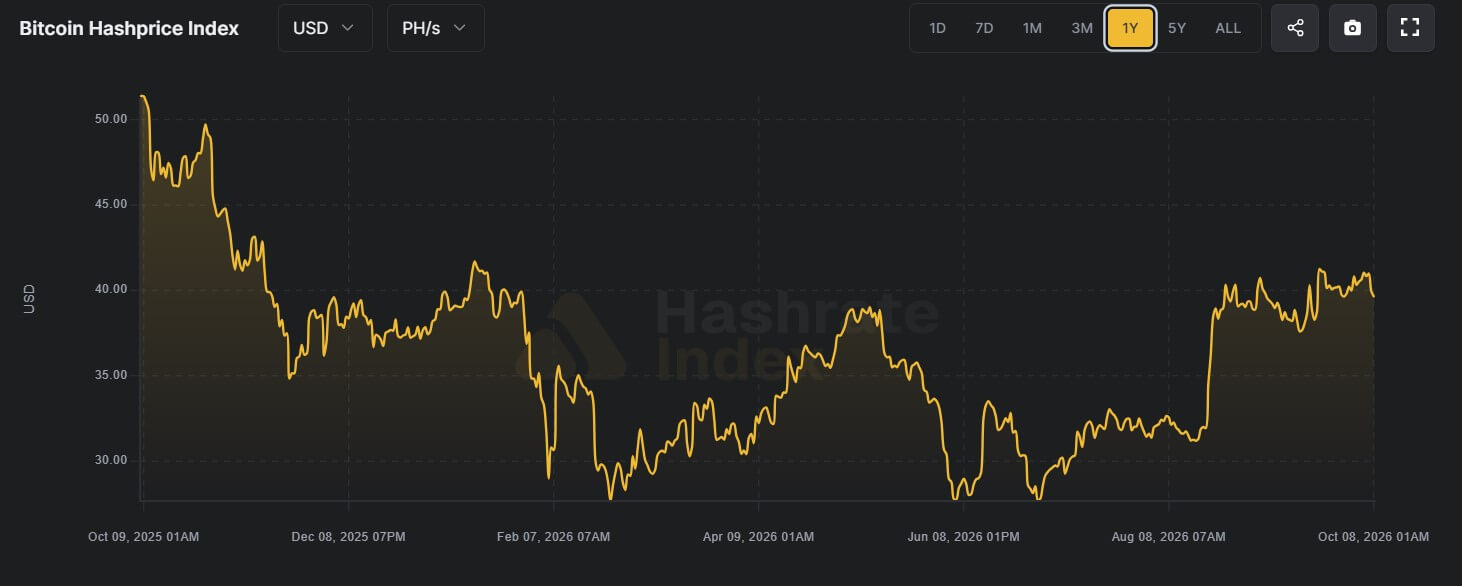
That marks a significant recovery from the industry’s financial difficulties earlier this year. CoinShares previously reported that hashprice fell to approximately $27.70 in June, reflecting a combination of lower Bitcoin prices, persistently weak transaction fees, and mining difficulty that remained elevated relative to revenue.
The subsequent recovery has improved the economics of running mining equipment, although the gains vary considerably across operators depending on electricity costs, hardware efficiency and financing obligations.
Bitcoin’s rally reverses months of mining distress
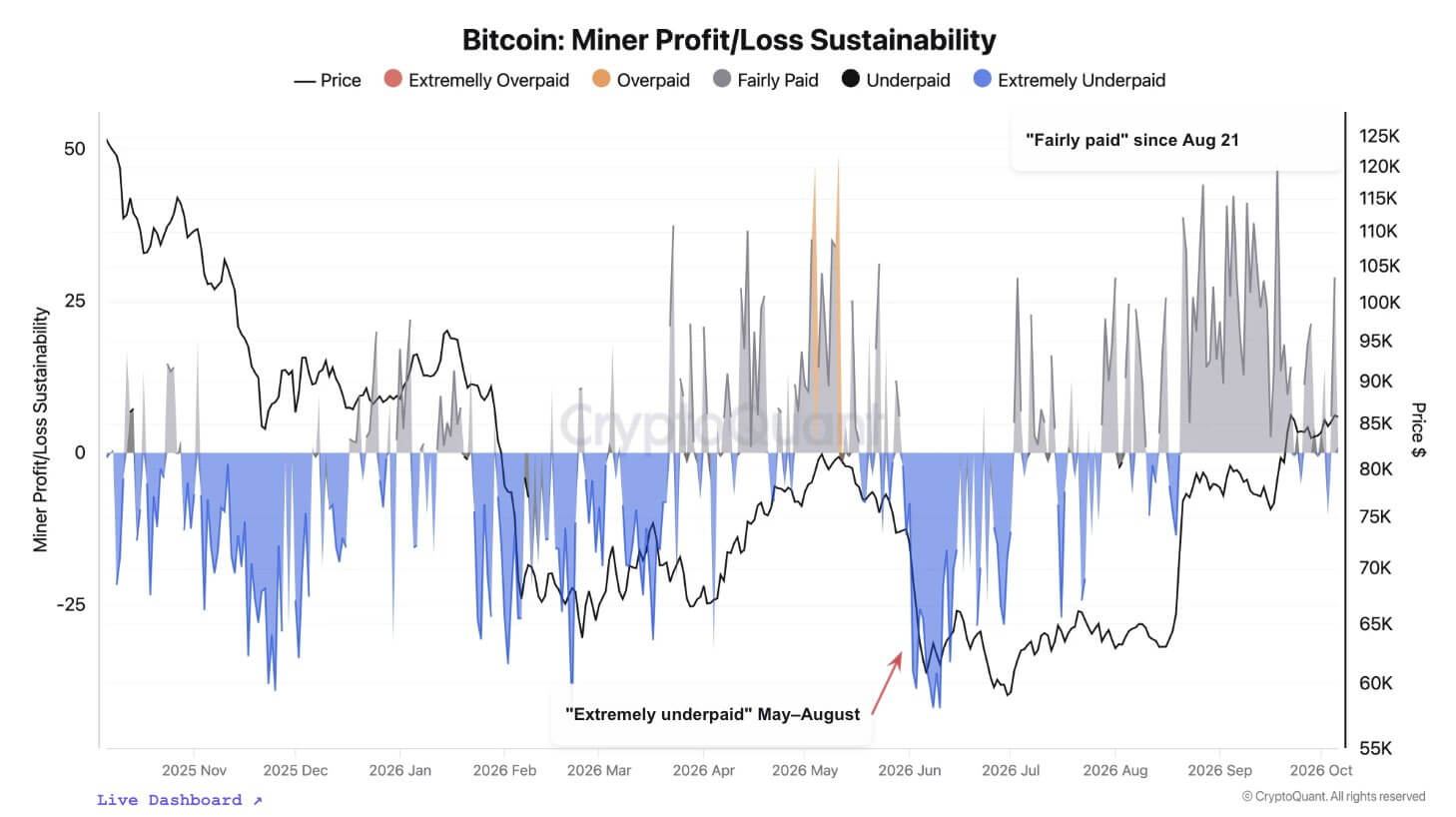
CryptoQuant’s Miner Profit/Loss Sustainability indicator shows that the industry’s financial position has improved substantially since August.
Between May and August, miners were largely classified as “extremely underpaid,” indicating that mining revenue was insufficient relative to the network’s difficulty under the firm’s methodology.
That changed on Aug. 21, when Bitcoin reached approximately $76,000. Since then, the indicator has generally remained in its “fairly paid” category, pointing out that mining revenue has recovered relative to the computational resources required to secure the network.
This improvement matters because mining operators receive Bitcoin-denominated rewards while electricity, equipment financing, and other operating expenses are generally paid in fiat currencies.
Higher Bitcoin prices therefore increase the dollar value of mining rewards without necessarily increasing operating costs immediately.
However, the higher hash price also reflects changes in network competition, since each unit of computing power is expected to generate more revenue when fewer miners compete for the same block rewards.
That dynamic helps explain why industry revenue and individual mining economics have improved even though Bitcoin’s network hashrate remains below its previous peak.
CryptoQuant reported that network hashrate has recovered to about 962 exahashes per second (EH/s), up from 899 EH/s on July 31, when declining prices squeezed operators’ margins.

The rebound has narrowed the network’s drawdown from a peak of approximately 18% in late July to 13%, likely because improving returns are encouraging miners to bring more computing capacity back online.
Nevertheless, the financial recovery still depends heavily on Bitcoin’s market value rather than increased transaction activity.
CryptoQuant found that daily transaction fees, measured using a seven-day average, rose from approximately $195,000 to $275,000. Those figures remain well below the $400,000 to $800,000 range recorded during parts of 2025.
Consequently, block subsidies still account for most mining revenue, leaving operators vulnerable to renewed pressure if Bitcoin prices retreat or network difficulty rises faster than earnings.
Miner selling pressure eases as profitability returns
Improved mining economics are also beginning to influence how operators manage their Bitcoin holdings.
CryptoQuant reported that extreme miner outflows have not occurred since Aug. 21, when approximately 29,000 BTC moved out of miner-associated wallets as Bitcoin advanced toward $76,000.
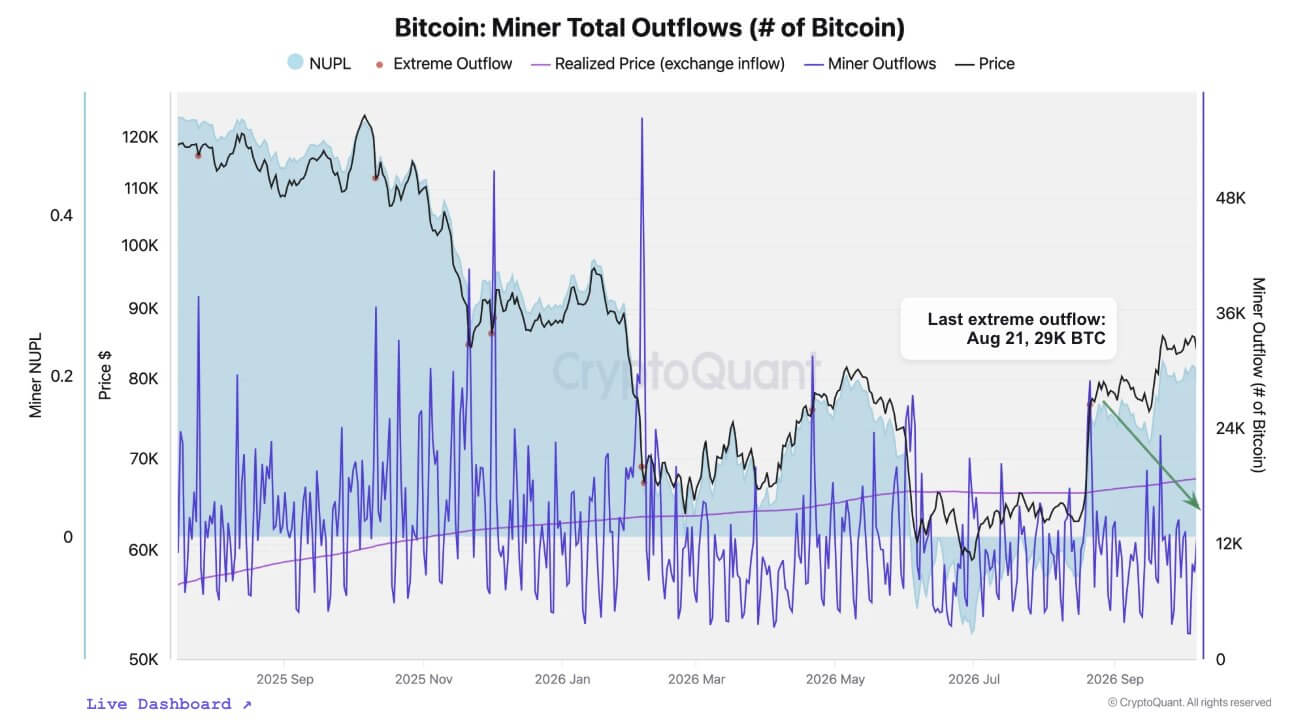
Since then, transfers have stayed within their normal range, with the latest daily reading at about 12,000 BTC.
Although wallet outflows don’t necessarily translate into immediate market sales, the decline could be an indicator that miners face less pressure to move large amounts of Bitcoin after months of financial strain.
The change is also apparent among some of the network’s oldest participants.
According to CryptoQuant, Satoshi-era miners, excluding addresses associated with Patoshi, transferred approximately 600 BTC out of their wallets in September. That was roughly a 70% decline from the approximately 2,000 BTC recorded in January.
Their combined holdings remain substantial at about 590,000 BTC, so changes in their spending activity matter for the market’s potential supply outlook.
Meanwhile, addresses holding between 100 and 1,000 BTC have stopped reducing their aggregate balances after months of depletion.
The cohort’s combined holdings declined approximately 20% from 64,000 BTC in December 2025 to roughly 51,000 BTC by early September. Since then, balances have remained relatively stable.
That stabilization could be a sign that miners have become less reliant on drawing down existing reserves as operating conditions improve.
For Bitcoin investors, the reduced selling pressure could remove one source of supply that weighed on the market during the downturn. However, the miners have yet to demonstrate a sustained return to accumulation.
Bitcoin’s $80,000 support level emerges as a test for mining profits
Meanwhile, emerging constraints also limit how far the industry’s financial recovery can extend.
As miners reactivate equipment and network competition intensifies, rising difficulty could compress hash price again unless Bitcoin’s market value keeps climbing.
CryptoQuant identified Bitcoin’s 365-day moving average near $80,000 as an important short-term support level, followed by its 200-day moving average around $71,000.
A sustained decline toward those levels could test the revenue gains miners have accumulated since July, particularly among operators using older, less efficient equipment.
A durable recovery would be marked by whether larger miners begin rebuilding their Bitcoin reserves while network hashrate continues to recover, suggesting that improving revenues are sufficient to cover operating expenses and support renewed accumulation despite increasing competition.