

Close Menu
    Facebook X (Twitter) Instagram
    Facebook Instagram YouTube
    Crypto Go Lore News
    Subscribe
    Monday, November 16
    • Home
    • Market Analysis
    • Latest
      • Bitcoin News
      • Ethereum News
      • Altcoin News
      • Blockchain News
      • NFT News
      • Market Analysis
      • Mining News
      • Technology
      • Videos
    • Trending Cryptos
    • AI News
    • Market Cap List
    • Mining
    • Trading
    • Contact
    Crypto Go Lore News
    Home»Mining»Can Bitcoin use Britain’s wasted wind?
    Mining

    Can Bitcoin use Britain’s wasted wind?

    CryptoExpertBy CryptoExpertNovember 16, 2026No Comments5 Mins Read
    Share Facebook Twitter Pinterest Copy Link LinkedIn Tumblr Email VKontakte Telegram
    Can Bitcoin use Britain’s wasted wind?
    Share
    Facebook Twitter Pinterest Email Copy Link
    Coinbase


    Britain’s grid operator forecasts about £4 billion in costs from transmission bottlenecks in 2027, putting a practical question to Bitcoin mining’s flexible-power pitch: can miners cut costs by using Scottish wind that cannot reach other consumers?

    The National Energy System Operator (NESO) published the forecast on Nov. 12. Its latest cost breakdown shows why the answer depends on where a mine connects and which expense it actually avoids.

    Thermal constraints arise when transmission lines cannot safely carry all the available electricity. NESO can then pay generators to reduce output while securing replacement supply elsewhere.

    The forecast concerns thermal constraints, rather than all electricity balancing costs. It is sensitive to gas prices and network availability. NESO estimates costs would be 16% lower without network outages, although those outages also enable reinforcement intended to ease future bottlenecks.

    okex

    In its Nov. 9 outturn explanation, NESO reported total balancing costs of about £3 billion for 2025/26, including roughly £2 billion for thermal constraints. A little under £500 million was paid to wind farms to turn down.

    Around 75% of thermal constraint costs paid for replacement energy, predominantly from gas units.

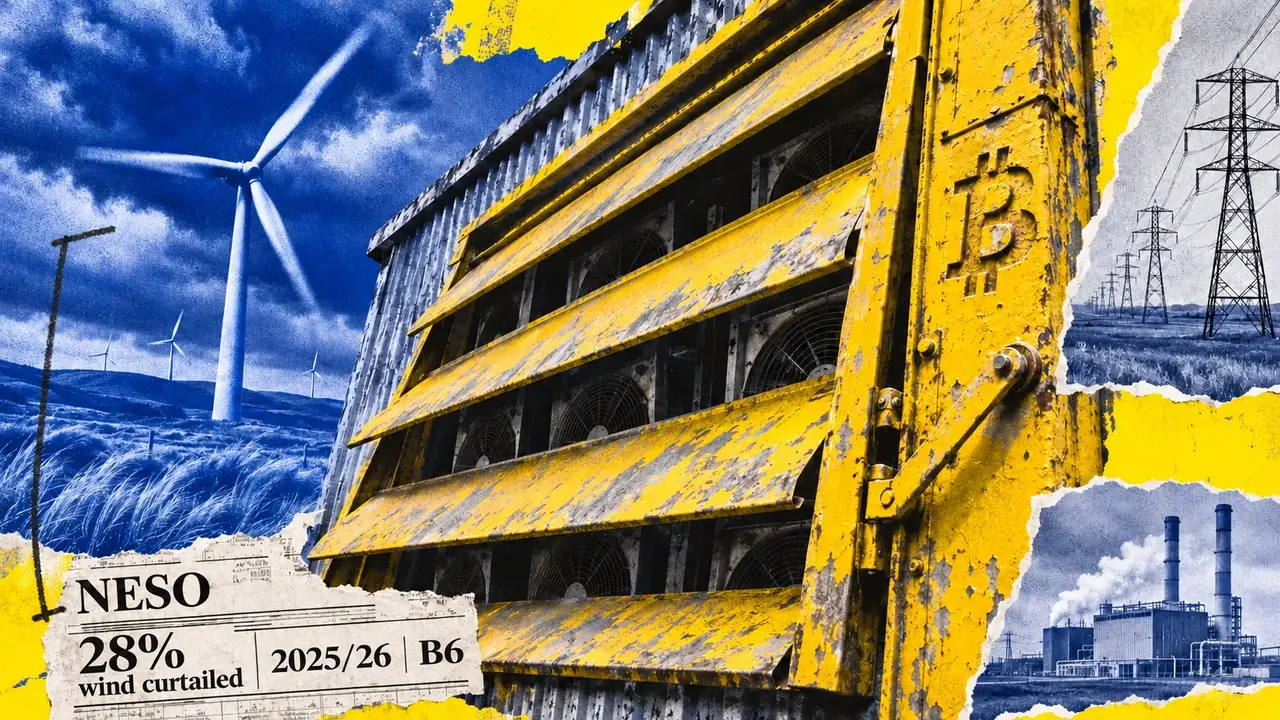
    Scotland nevertheless presents a potential use case. NESO says 28% of wind in the northern area above a transmission boundary known as B6 was curtailed in 2025/26, compared with 13% across Great Britain.

    Related Reading

    Even if Bitcoin rises 30% a year this renewable mining model still loses money as hashrate keeps pace

    A flexible mine could reduce wind turn-down costs by consuming otherwise curtailed electricity at a connection and time that helps manage the relevant bottleneck. But adding northern demand does not itself deliver more power south. While the boundary remains binding and southern demand is unchanged, replacement supply remains necessary there.

    That limits the savings claim: reduced wind turn-down does not establish an equivalent reduction in gas generation, consumer bills or emissions.

    The Catalyst

    Know what’s moving crypto.

    Most thermal constraint spending pays for replacement energy01 / WHERE THE COST GOES~75%Replacement energyPredominantly gas · 2025/26 thermal constraint costsMost spending replaces power elsewhere.Other constraint costsApproximate cost share. This is not the 2027 forecast’s breakdown.

    About 75 percent paid for replacement energy in 2025/2601 / WHERE THE COST GOES~75%Replacement energyPredominantly gas2025/26 thermal constraint costsApproximate cost share, not a breakdownof the 2027 forecast.

    02 / Follow the constrained power

    02 / Follow the constrained powerWind turned downLocal mine turns up

    Illustration: wind is curtailed behind a binding boundary; replacement supply still serves unchanged southern demand.

    Illustrative wind curtailment and replacement supplyNorthern windSouthern demandBottleneckLimited transferWind turned downOutput withheldbehind the bottleneckReplacementsupplyA network limit can require two balancing actions.Illustrative mechanism only; no power volumes or savings are modeled.
    Illustrative constrained power and wind turn-downNorthern windBottleneckWindturned downOutput withheldLimitedtransferSouthern demandReplacementsupply still neededIllustrative; no volumes or savings modeled.

    Illustration: mining uses some surplus behind a binding boundary; replacement supply still serves unchanged southern demand.

    Illustrative flexible mining behind a binding grid bottleneckNorthern windSouthern demandBottleneckLimited transferFlexible mineUses some otherwisecurtailed electricityReplacementsupplyLocal wind use can rise. Transfer capacity does not.Illustrative mechanism only; no power volumes or savings are modeled.
    Illustrative constrained power and local miningNorthern windBottleneckFlexiblemineSome surplus usedLimitedtransferSouthern demandReplacementsupply still neededIllustrative; no volumes or savings modeled.

    A local mine may reduce wind turn-down costs while replacement supply is still needed beyond the bottleneck.

    The 2025/26 share is not a 2027 breakdown. Mining state is conditional on suitable connection, timing and dispatch. No Bitcoin-specific approval, payment entitlement, gas saving or consumer benefit is established.

    Using wasted wind needs a business case

    The Cambridge Centre for Alternative Finance’s mining survey offers evidence that miners can adjust consumption. Respondents reported curtailing 888 GWh of electrical load during 2023. That measures demand turned down, while absorbing surplus Scottish wind would require demand to turn up at the right location and time.

    The survey covered 49 firms representing 48% of Bitcoin’s network hashrate at collection, with activity concentrated in North America. It does not establish profitable intermittent mining in Britain. Electricity accounted for more than 80% of surveyed miners’ cash-based operating expenses.

    Related Reading

    Bitcoin miners have until 2027 to prove they deserve power on America’s overloaded grid

    NESO’s November thermal constraints report identifies additional flexible demand in constrained areas as a mitigation. Its March 5 proposed Demand for Constraints design focused on Scottish boundaries. It contemplated registration and dispatch through the Balancing Mechanism, NESO’s system for directing electricity supply and demand in real time, with routes for both new connections and existing assets creating additional flexible demand. The March design proposed service deliveries from 2028, after the year covered by the forecast. It did not establish a Bitcoin-specific approval or payment entitlement.

    For a mine, a usable connection, service qualification and enough operating hours to cover costs would all matter. For consumers, the relevant comparison is the expense actually avoided after accounting for the costs the project adds.

    NESO’s test is overall system cost. The roughly £4 billion forecast identifies the scale of a grid problem; it does not price a mining solution.

    Related Reading

    Bitcoin miners’ daily revenue per unit of computing power falls 8.7%


    Source link

    okex
    Share. Facebook Twitter Pinterest LinkedIn Tumblr Email Telegram Copy Link
    CryptoExpert
    • Website

    Related Posts

    Mining

    Keel Shuts US Bitcoin Mining Operations as Q2 Revenue Falls 50%

    November 15, 2026
    Mining

    Futurebit Bitcoin Mining Rigs Hit Retail Stores as Solo Miners Keep Winning Big

    November 14, 2026
    Mining

    MARA dumps Bitcoin to erase a $750M collateral risk

    November 13, 2026
    Mining

    HIVE, MARA Mine More Bitcoin as Mining Revenue Falls

    November 12, 2026
    Mining

    MARA Dumps Over 13,500 Bitcoin for Over $1B to Wipe out Its BTC Loans

    November 11, 2026
    Mining

    DESMANTELAN CRIPTOMINA EN CULIACÁN 🚨 130 máquinas con luz robada #Shorts

    November 10, 2026
    Add A Comment
    Leave A Reply Cancel Reply

    Recommended
    Editors Picks

    AI Day Seoul Showcases Korea’s Leadership in Physical and Agentic AI

    November 16, 2026

    Tether wants its gold token to rival ETFs

    November 16, 2026

    Can Bitcoin use Britain’s wasted wind?

    November 16, 2026

    US Crypto Trust Charters Face Senate Scrutiny

    November 16, 2026
    Latest Posts

    We are a leading platform dedicated to delivering authoritative insights, news, and resources on cryptocurrencies and blockchain technology. At Crypto Go Lore News, our mission is to empower individuals and businesses with reliable, actionable, and up-to-date information about the cryptocurrency ecosystem. We aim to bridge the gap between complex blockchain technology and practical understanding, fostering a more informed global community.

    Latest Posts

    AI Day Seoul Showcases Korea’s Leadership in Physical and Agentic AI

    November 16, 2026

    Tether wants its gold token to rival ETFs

    November 16, 2026

    Can Bitcoin use Britain’s wasted wind?

    November 16, 2026
    Newsletter

    Subscribe to Updates

    Get the latest Crypto news from Crypto Golore News about crypto around the world.

    Facebook Instagram YouTube
    • Contact
    • Privacy Policy
    • Terms Of Service
    • Social Media Disclaimer
    • DMCA Compliance
    • Anti-Spam Policy
    © 2026 CryptoGoLoreNews. All rights reserved by CryptoGoLoreNews.

    Type above and press Enter to search. Press Esc to cancel.

    bitcoin
    Bitcoin (BTC) $ 65,242.00
    ethereum
    Ethereum (ETH) $ 1,827.79
    tether
    Tether (USDT) $ 0.999373
    bnb
    BNB (BNB) $ 592.80
    usd-coin
    USDC (USDC) $ 0.999675
    xrp
    XRP (XRP) $ 0.957763
    solana
    Solana (SOL) $ 71.75
    tron
    TRON (TRX) $ 0.305204
    staked-ether
    Lido Staked Ether (STETH) $ 2,265.05
    figure-heloc
    Figure Heloc (FIGR_HELOC) $ 1.05