



In 2024, restaking rapidly transformed from a nascent concept into a cornerstone of the DeFi ecosystem, driven by its potential to significantly enhance blockchain security and efficiency. Spearheaded by Ethereum, with EigenLayer leading the charge, this sector has witnessed explosive growth, with total value locked (TVL) now exceeding $19 billion.
As restaking continues to gain momentum, it is reshaping the security landscape of decentralized networks, offering innovative solutions to overcome the limitations of traditional Layer 1 blockchains and paving the way for broader adoption across the industry.
Overview of Restaking
This year, the restaking sector evolved from an emerging concept to a significant reality of the DeFi ecosystem. This rapid development is primarily motivated by the opportunity to greatly increase blockchain security and efficiency. Ethereum has emerged as the leading Blockchain for this narrative, thanks primarily to EigenLayer’s pioneering efforts. EigenLayer has had a tremendous impact on the market, resulting in considerable growth in total value locked (TVL), which today exceeds $19 billion.
EigenLayer TVL Growth in 2024

Restaking seeks to address a major issue: fragmented blockchain security. Traditionally, decentralized networks had to develop their own security practices, frequently using proof-of-stake (PoS) approaches. This is an expensive and time-consuming procedure that requires new networks to attract users ready to stake their tokens. This leads to a fragmented security landscape in which emerging networks frequently struggle to match the strength of existing ones like Ethereum.
EigenLayer has become widely recognized as the pioneer in helping mitigate this constraint. Its approach has set a standard for other players, ensuring its market dominance. Babylon is adding staking capabilities to Bitcoin, and Picasso is working on integrating Restaking with Solana. These examples demonstrate the expanding popularity of this sub-sector across various blockchain ecosystems, keen on tackling shared security challenges.
Deep Dive into EigenLayer
EigenLayer describes itself as a “restaking collective for Ethereum” providing an important benefit to the DeFi ecosystem. EigenLayer is fundamentally a restaking middleware, translating Ethereum’s security paradigm into a modular service that can be used by a wide range of decentralized applications. EigenLayer creates a marketplace for decentralized trust, allowing other protocols to improve their security without having to build their own staking infrastructure from scratch.
The architecture for EigenLayer is based on three components:
1. Restakers are individuals or entities that make use of their Staked position to further support additional applications on the Ethereum network. This allows restakers to repurpose their staked assets, maximizing their earnings.
2. Node Operators are responsible for running and maintaining the EigenLayer functionality and network. These operators collect the delegated stake, run validator operations, and earn fees from Ethereum’s proof-of-stake (PoS) rewards. However, if they fail to meet EigenLayer’s prerequisites, they risk having their share, as well as that of their delegators, slashed.
3. Actively Validated Services (AVSs) are various services that rely on EigenLayer for security and validation operations. AVSs attract restakers to improve their security, resulting in a symbiotic relationship where both parties benefit (Restakers earn extra rewards, while AVSs security is taken care of).

[1] – Comparison of the ecosystem of AVSs today and with Eigenlayer (Source)
By creating an open marketplace for pooled security, Eigenlayer removes the significant costs of building new security models for individual protocols. This approach not only increases the value of staked ETH, but also improves the overall security of the Ethereum Network and the AVSs it supports.
The Rise of Liquid Restaking Protocols
The introduction of liquid restaking protocols transformed the restaking scene, boasting over $15 Billion in Total Value Locked (TVL). These protocols leverage EigenLayer’s infrastructure to provide Restaking products that enable users to unlock additional liquidity from their re-staked assets.
*
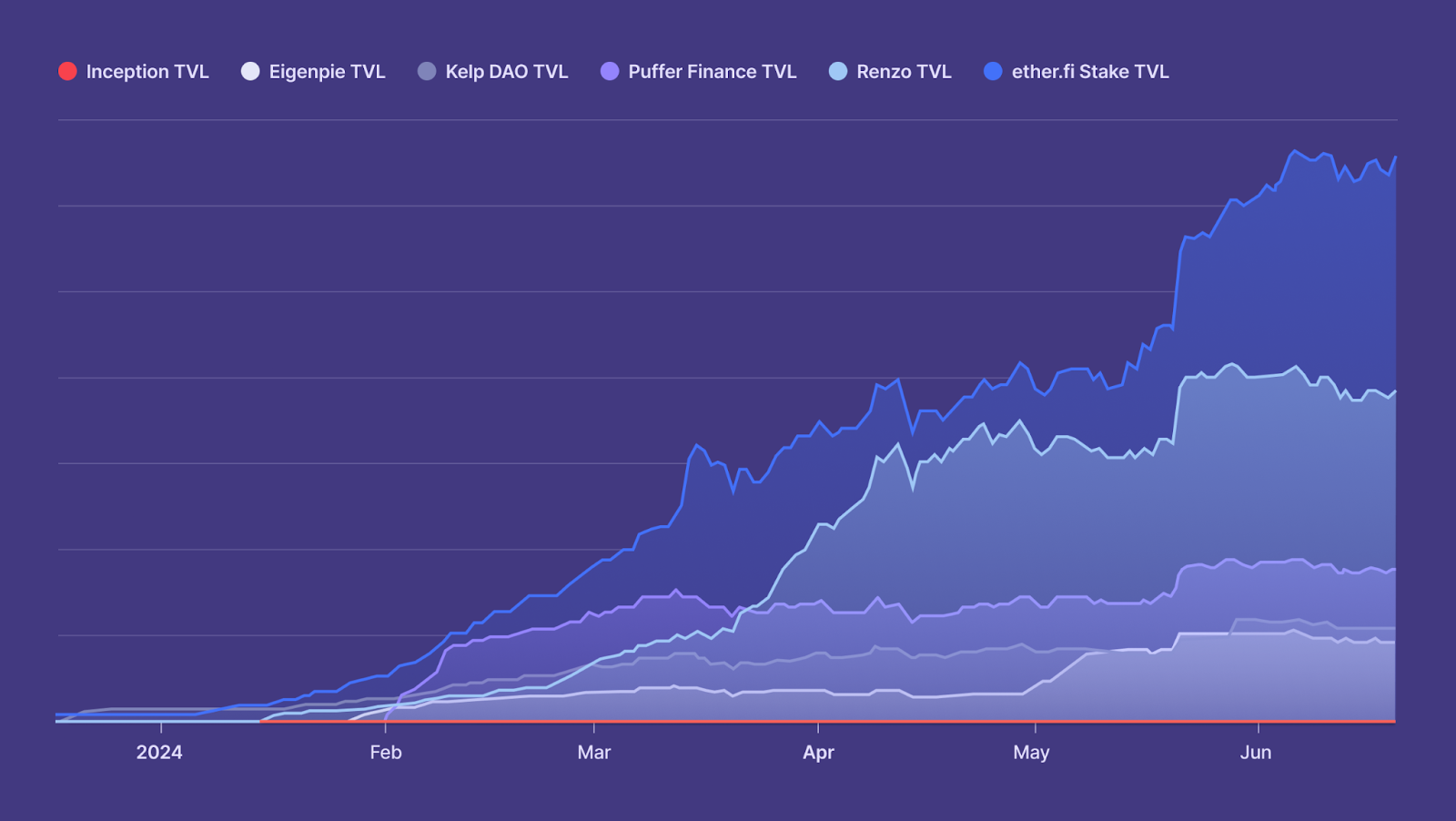
Ethereum Liquid Restaking Protocols Growth in 2024
Liquid Restaking protocols introduce Liquid Restaking Tokens (LRTs), which are derivatives that represent Restaked positions. When users Restake their tokens via these protocols, they get LRTs in exchange. These LRTs can then be exchanged or used freely in other Defi applications, releasing previously locked-up liquidity.
As Liquid Restaking Protocols continue to rapidly evolve, understanding the different types of Restaking Protocols and Liquid Restaking Tokens (LRTs) is crucial for users looking to optimize their participation and rewards. Below are the primary types of Liquid Restaking:
Native Liquid Restaking
By combining a staking and restaking module under one roof, Native Restaking allows users to leverage EigenLayer’s protocol with a single click. This simplifies the entire process for users, allowing them to Stake and Restake their Native Ethereum, consequently earning two layers of rewards while just managing one singular asset: A Native Liquid Restaking Token (nLRT).
The main benefit of Native Liquid Restaking is its convenience, since it accrues both levels of Native and Restaking Rewards into a single asset, making it easier to manage and maximize returns.
LST Restaking
On the other hand, Liquid Staking Token (LST) Restaking involves re-staking Liquid derivatives of staked assets in return for a Liquid Restaking Token (LRT). This sort of Restaking approach provides more flexibility by allowing users to use their liquid staking tokens in a variety of ways, increasing the overall utility of their position.
One distinct advantage of LST Restaking is the flexibility to leverage different Defi strategies independently. Users can Restake their LSTs in various protocols, each tailored to specific yield or risk profiles, allowing for highly customized and strategic investment approaches.
Challenges to Overcome in Restaking
While Liquid Restaking Protocols have substantially improved the Defi Landscape, there are some difficulties that must be addressed before further optimization. Let’s dive into these challenges and the answers that can help us solve them:
Basket-Based Solutions
One of the fundamental issues in managing LST Restaking is that the majority of Liquid Restaking Protocols pool assets all together into a singular “Basket”. While this strategy simplifies diversification, it introduces several complexities and risks:
– Performance Risks: Since the different LSTs are pooled, poor performance of one asset can have an impact on overall returns.
– Management Complexity: Balancing the weights of various LSTs inside a basket requires ongoing monitoring and adjustment
– Increased Risk Exposure: Restakers are exposed to the combined risk of all LSTs in the basket, which may increase return volatility
To tackle this challenge, Isolated Liquid Restaking offers a more effective solution by representing each restaked asset with a distinct Isolated Liquid Restaking Token (iLRT). This approach overcomes the limitations of basket-based solutions and brings several key advantages:
– Transparency: Each asset and its returns are tracked separately, giving restakers full visibility
– Minimized Risks: Isolating each restakers risk reduces the impact of poor performance on other assets, improving overall investment stability
– Control over Investments: Investors can make informed decisions based on the performance of each individual asset, allowing for more personalized investment strategies and optimized returns.
Liquid Restaking Protocols like InceptionLRT or EigenPie leverage the power of iLRTs, maximizing rewards for users without sacrificing security, by following industry best-practices.
Unstaking Issues
Another key difficulty in the Restaking ecosystem is the lack of effective unstaking solutions. Taking this into account, some prominent Restaking Protocols still lack this feature, therefore, users cannot quickly access their restaked assets.
Moreover, for protocols that do support unstaking, there is still a 7-day mandatory unbounding period imposed by EigenLayer. This extended lock-up period ties up capital and reduces flexibility, discouraging participation and increasing opportunity costs.

EigenLayer documentation on 7-day withdrawal delay (Source)
A Flash Unstaking feature is essential to address these liquidity constraints. Such a feature would allow users to gain immediate access to their restaked assets, eliminating the need for a 7-day unbounding period. This approach would offer several benefits, such as:
– Immediate Liquidity: Users can easily convert their restaked position back into their original forms, allowing them to access their funds when needed.
– Increased Flexibility: With instantaneous unstaking, users can better manage their portfolios and take advantage of new Defi possibilities that arise.
– Improved User Experience: Providing quick access to restaked assets boost trust and confidence in a protocol, resulting in more participation and adoption.
By solving these inherent constraints through Isolated Liquid Restaking and Immediate Unstaking features, the Restaking landscape can become even more robust, versatile, and user-friendly, driving greater adoption to the rapidly emerging market.
InceptionLRT: Overcoming Challenges and Leading the Future
InceptionLRT tackles the challenges associated with restaking head-on, ensuring its community a smooth, secure, and rewarding experience. This is how InceptionLRT is addressing these key issues:
– Solving Liquidity constraints with Flash Unstake: InceptionLRT has a built-in feature called Flash Unstake that gives users immediate liquidity by bypassing traditional unbounding periods associated with Restaking, which in EigenLayer case is 7-15 days. As a result, users can effectively manage their assets without enduring long waiting periods.
– Isolated Liquid Restaking Approach: The protocols also utilizes an isolated liquid restaking (iLRTs) approach, following with industry best practices to lessen the risks associated with basket-based solutions.This ensures each restaked asset is independently managed, allowing for better risk management and optimization of returns.
By addressing these important problems, InceptionLRT establishes itself as a front-runner in the restaking industry by improving the security and usability of its platform. InceptionLRT is setting the pace for the future of the space with its cutting-edge features and unwavering dedication to industry standards.
You may explore more on restaking on InceptionLRT page and unlock a new world of rewards for your assets!
Closing Thoughts
Restaking has become one of the fastest-growing Defi sub-sectors in 2024, with the potential to alter the public blockchain infrastructure. However, with rapid innovation comes inherent risks. The success of EigenLayer and the rise of Liquid Restaking Protocols demonstrate strong demand and interest, suggesting that a significant market shift is imminent. However, since Restaking is still in its early stages, unforeseen challenges and potential setbacks may arise.
As the space continues to mature, it will be interesting to see which protocols and solutions take the lead as the restaking industry develops. Following industry best practices and addressing user experience will be vital in defining industry leaders. While protocols with the highest TVL might initially appear dominant, those that prioritize remarkable features and industry best-practices will inevitably dominate the Restaking landscape.
João Simões Bio:
João Simões is a fintech and fund management expert with over 9 years of experience. He is the CEO and Co-founder of InceptionLRT, a DeFi Business Developer at Tagus Labs, and a member of Staking Circle. João founded BitMasters, Portugal’s first Bitcoin mining firm. He holds degrees from the London School of Economics and UC Berkeley and won an award for his master’s thesis on crypto-currencies. He worked in Private Equity focusing on African projects. Currently, he teaches Corporate Finance in Deakin University’s Global MBA program and advises various Web3 projects and companies.
Linkedin | X (Twitter)
Disclaimer
In compliance with the Trust Project guidelines, this guest expert article presents the author’s perspective and may not necessarily reflect the views of BeInCrypto. BeInCrypto remains committed to transparent reporting and upholding the highest standards of journalism. Readers are advised to verify information independently and consult with a professional before making decisions based on this content. Please note that our Terms and Conditions, Privacy Policy, and Disclaimers have been updated.



