



[ad_1]
Hypergraphs, which extend traditional graphs by allowing hyperedges to connect multiple nodes, offer a richer representation of complex relationships in fields like social networks, bioinformatics, and recommender systems. Despite their versatility, generating realistic hypergraphs is challenging due to their complexity and the need for effective generative models. While traditional methods focus on algorithmic generation with predefined properties, deep learning for hypergraph generation still needs to be explored. Due to their variable hyperedge sizes, existing graph generation methods, such as one-shot and iterative models, need help with hypergraphs. Recent advancements aim to address these challenges by leveraging spectral equivalences and hierarchical expansion techniques to capture hypergraph structures better.
Researchers from LTCI, Télécom Paris, and Institut Polytechnique de Paris have developed a hypergraph generation method called HYGENE, which addresses the challenges of creating realistic hypergraphs through a diffusion-based approach. HYGENE operates on a bipartite hypergraph representation, starting with a basic pair of connected nodes and expanding iteratively using a denoising diffusion process. This method constructs the global hypergraph structure while refining local details. HYGENE is the first deep learning-based hypergraph generation model validated on both synthetic and real-world datasets. Key contributions include pioneering deep learning methods for hypergraphs, adapting graph concepts to hypergraphs, and providing robust theoretical and empirical validations.
Graph generation using deep learning began with GraphVAE, which uses autoencoders to embed and generate graphs. Subsequent advancements included using recurrent neural networks to improve adjacency matrix generation and adapting diffusion models for graph generation. A notable departure involved reversing a coarsening process, where graphs are progressively simplified and reconstructed. In contrast to these methods, HYGENE addresses hypergraph generation, extending the concept to higher-order structures. Unlike sequential edge prediction, HYGENE employs a hierarchical approach that focuses on predicting the number and composition of hyperedges, offering a more nuanced method for generating complex hypergraphs.
The method outlined involves generating hypergraphs by learning from existing hypergraph datasets. The approach begins with a bipartite graph representation, using a weighted clique and star expansion. The process includes coarsening, simplifying the hypergraph by merging nodes and edges while preserving spectral properties, and expanding, which involves duplicating nodes and refining connections to reconstruct the hypergraph. The model employs a denoising diffusion framework to recover original features from noisy data and uses spectral conditioning to ensure accurate reconstruction. The method iteratively refines the bipartite representation to achieve high-quality hypergraph generation.

The study outlines the experimental setup, including datasets and evaluation metrics. HYGENE is compared with baselines such as HyperPA, a Variational Autoencoder (VAE), a Generative Adversarial Network (GAN), and a standard 2D diffusion model. The experiments aim to demonstrate that HYGENE can generate the desired hyperedge distributions, replicate structural properties, and validate the importance of components like spectrum-preserving coarsening and hyperedge upper bounds. Evaluation involves four synthetic hypergraph datasets and three ModelNet40 subsets. Results indicate that HYGENE excels in structural accuracy and compliance with hypergraph properties. Ablation studies highlight the advantages of the proposed approach.
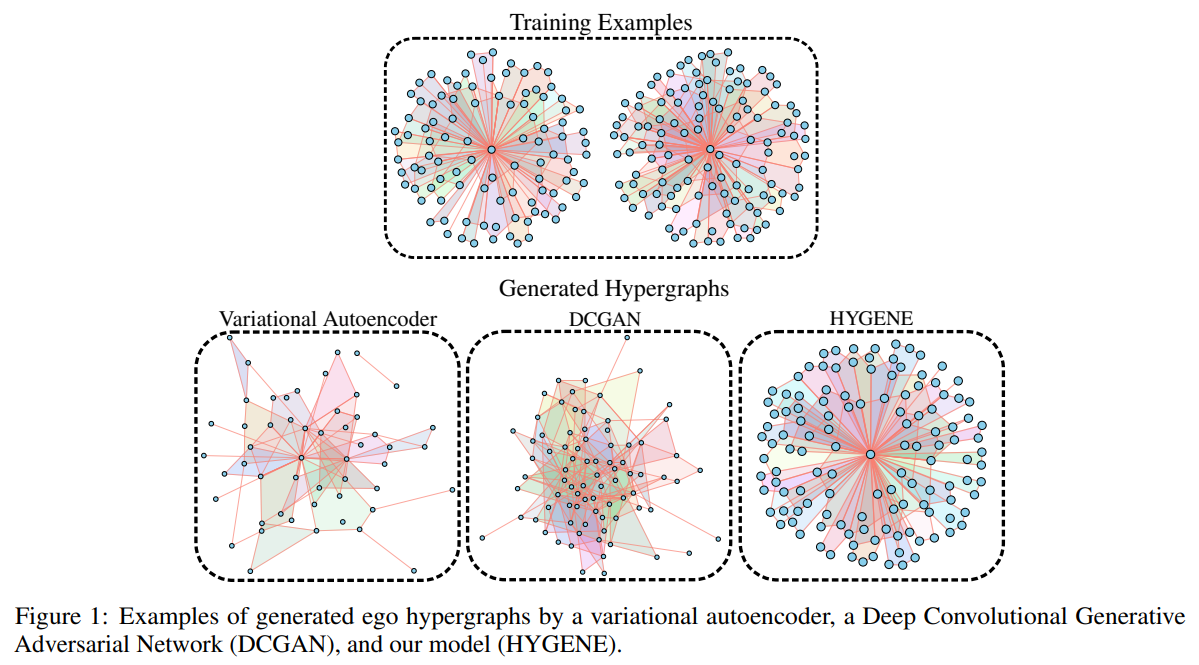
In conclusion, HYGENE represents the first deep learning-based approach for hypergraph generation, enhancing previous iterative local expansion and coarsening methods. It employs a diffusion-based technique, starting with connected nodes and expanding them iteratively to construct hypergraphs. The process utilizes a denoising diffusion model to add nodes and hyperedges, progressively refining global and local structures. HYGENE effectively generates hypergraphs from specific distributions, addressing the challenges of their inherent complexity. This work marks a significant advancement in graph generation, providing a foundation for future research in hypergraph modeling across diverse domains.
Check out the Paper. All credit for this research goes to the researchers of this project. Also, don’t forget to follow us on Twitter and LinkedIn. Join our Telegram Channel. If you like our work, you will love our newsletter..
Don’t Forget to join our 50k+ ML SubReddit

Sana Hassan, a consulting intern at Marktechpost and dual-degree student at IIT Madras, is passionate about applying technology and AI to address real-world challenges. With a keen interest in solving practical problems, he brings a fresh perspective to the intersection of AI and real-life solutions.
[ad_2]
Source link