

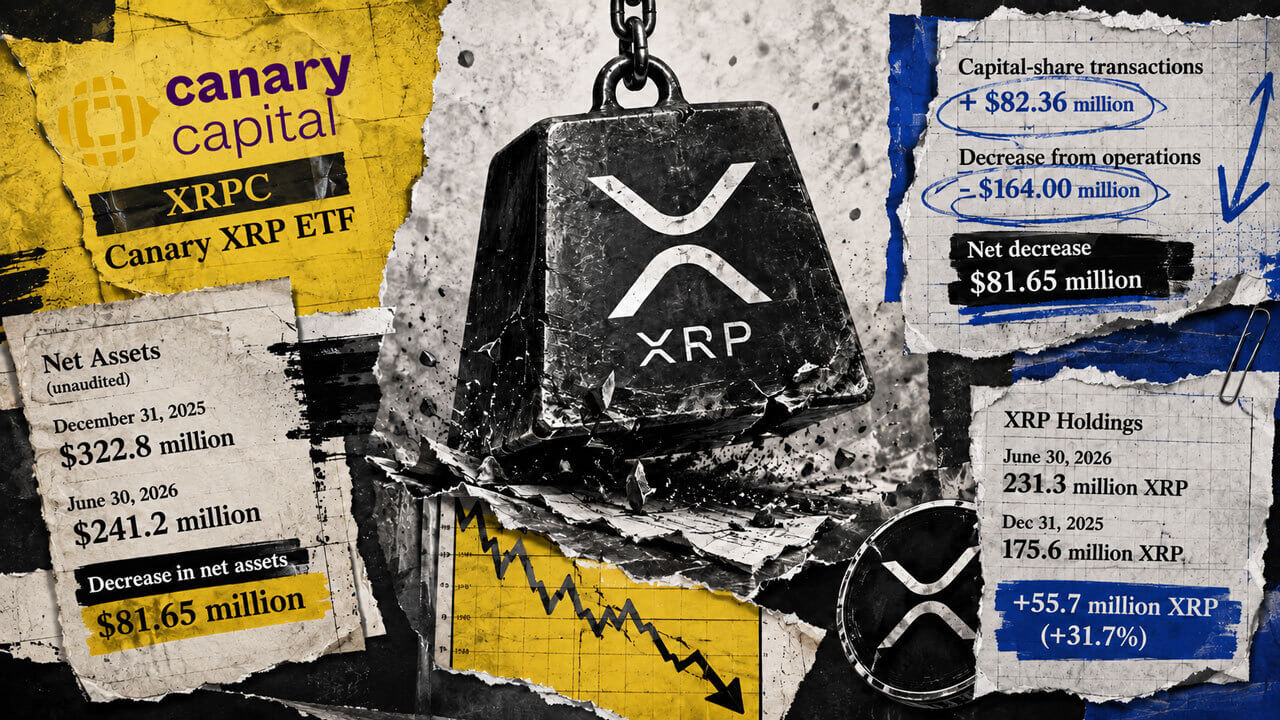

Canary Capital’s Canary XRP ETF (XRPC) ended the first half of 2026 with $81.6 million less in net assets even after capital-share transactions added a net $82.4 million, showing how falling asset values can overwhelm growth in an exchange-traded fund.
The fund’s unaudited Form 10-Q, filed Aug. 7, showed net assets declining from $322.8 million at Dec. 31, 2025, to $241.2 million at June 30, 2026.
The accounting bridge is direct: capital-share transactions increased net assets by $82.36 million, but the accounting decrease from operations, primarily unrealized XRP depreciation, reduced them by $164.00 million. The difference was the $81.65 million decline in net assets over the six-month period.
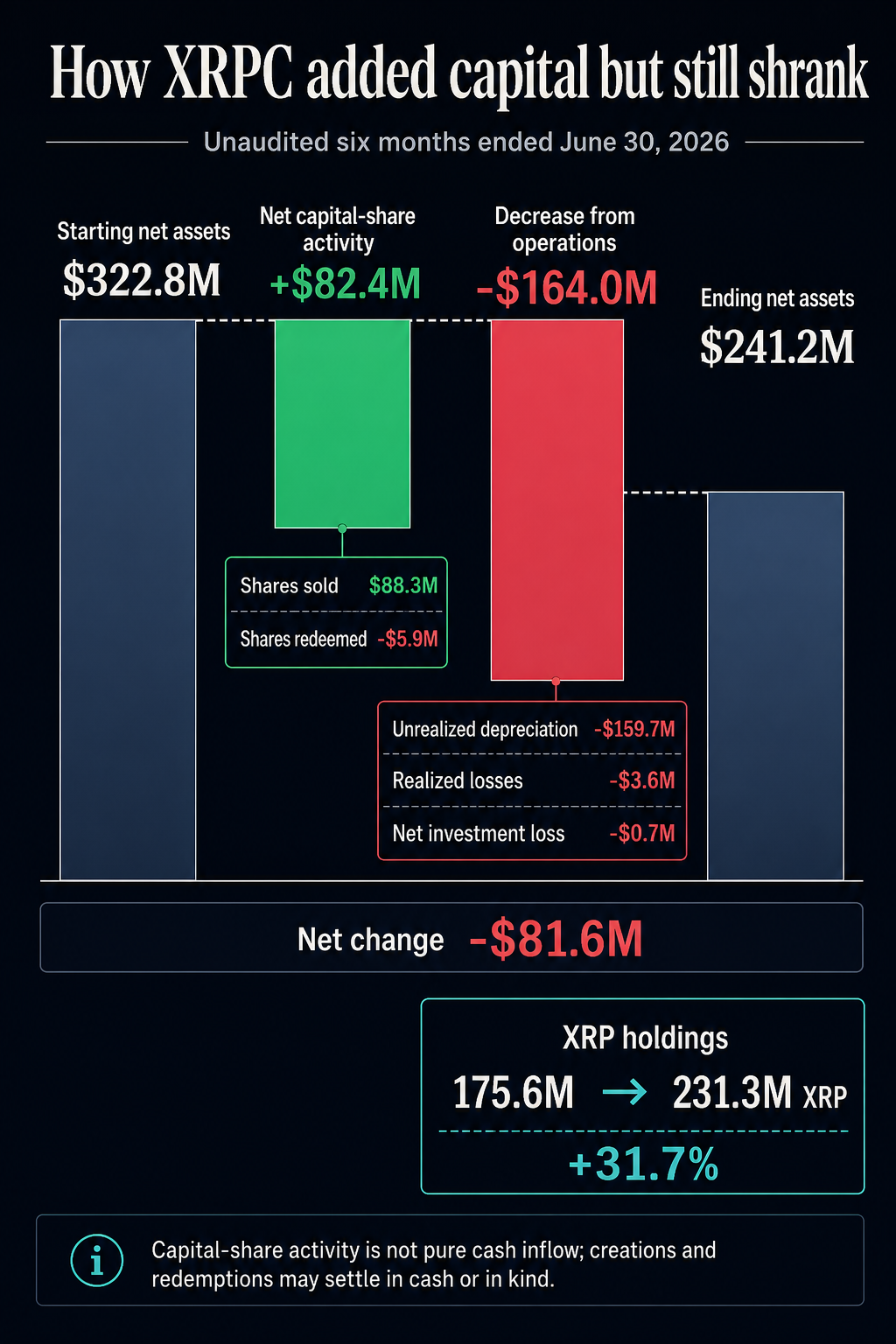
XRPC attributed $88.26 million to shares sold and $5.90 million to shares redeemed. Because authorized participants place XRPC’s creation and redemption orders and can settle them in cash or in kind, the $82.36 million is not equivalent to cash inflow and does not directly measure retail-investor buying. The filing does not disclose the period’s cash-versus-in-kind split.


Unrealized depreciation overwhelmed net share activity
Unrealized depreciation accounted for $159.70 million of the $164.00 million decrease from operations. The balance comprised $3.59 million of realized losses and a $716,898 net investment loss. All are unaudited figures for the full six months, not the second quarter alone.

The fund’s redemptions therefore did not exceed its new share activity. Net capital-share activity remained positive, but the accounting decrease from operations was nearly twice as large as the value added through capital transactions. Unrealized XRP depreciation, rather than fees or realized losses, dominated that decrease.
The contrast is clearest in XRPC’s holdings. The trust held 231.3 million XRP at June 30, up 55.7 million XRP, or 31.7%, from 175.6 million at the end of 2025. The quantity of XRP rose while unrealized depreciation reduced the dollar value recognized in the portfolio.

The fund also sold 3.93 million XRP to fund share redemptions during the first half, recording a $3.26 million realized loss on those sales. That was a loss recognized by the fund, not a measure of losses realized by individual XRPC shareholders.
XRPC’s filing captures two simultaneous movements: net capital-share activity and XRP units both increased, while depreciation cut the value of the larger token pool. The result was a fund with more XRP but $81.6 million less in net assets at midyear.
A Word of Caution on What “$82 Million Inflow” Actually Means
It’s tempting to read “$82.36 million in capital-share activity” as $82 million of fresh retail money flowing into XRP. That’s not quite accurate. Authorized participants — the institutions that handle ETF creation and redemption — can settle those transactions in cash or in kind (meaning, with XRP itself rather than dollars). The filing doesn’t break down how much of that $82.36 million was cash versus in-kind XRP, so it’s a measure of net capital-share activity, not a clean proxy for new investor demand.
FAQ
Did investors lose money on Canary’s XRP ETF?
The fund’s net assets fell $81.6 million despite $82.36 million in net capital-share activity, driven by a roughly 43% decline in XRP’s price during the period but individual investor outcomes depend on when they bought and sold shares, not just the fund’s aggregate net asset change.
Why did XRPC’s net assets fall if the fund added money and XRP holdings?
Because unrealized depreciation on the fund’s existing XRP holdings ($159.7 million) far outweighed the value added through new capital-share activity the fund held more XRP, but that XRP was worth significantly less per token.
Does the $82 million figure represent new retail investment?
Not precisely it reflects net capital-share activity, which authorized participants can settle in cash or in kind. The filing doesn’t disclose the cash-versus-in-kind split, so it shouldn’t be read as a direct measure of retail buying.