

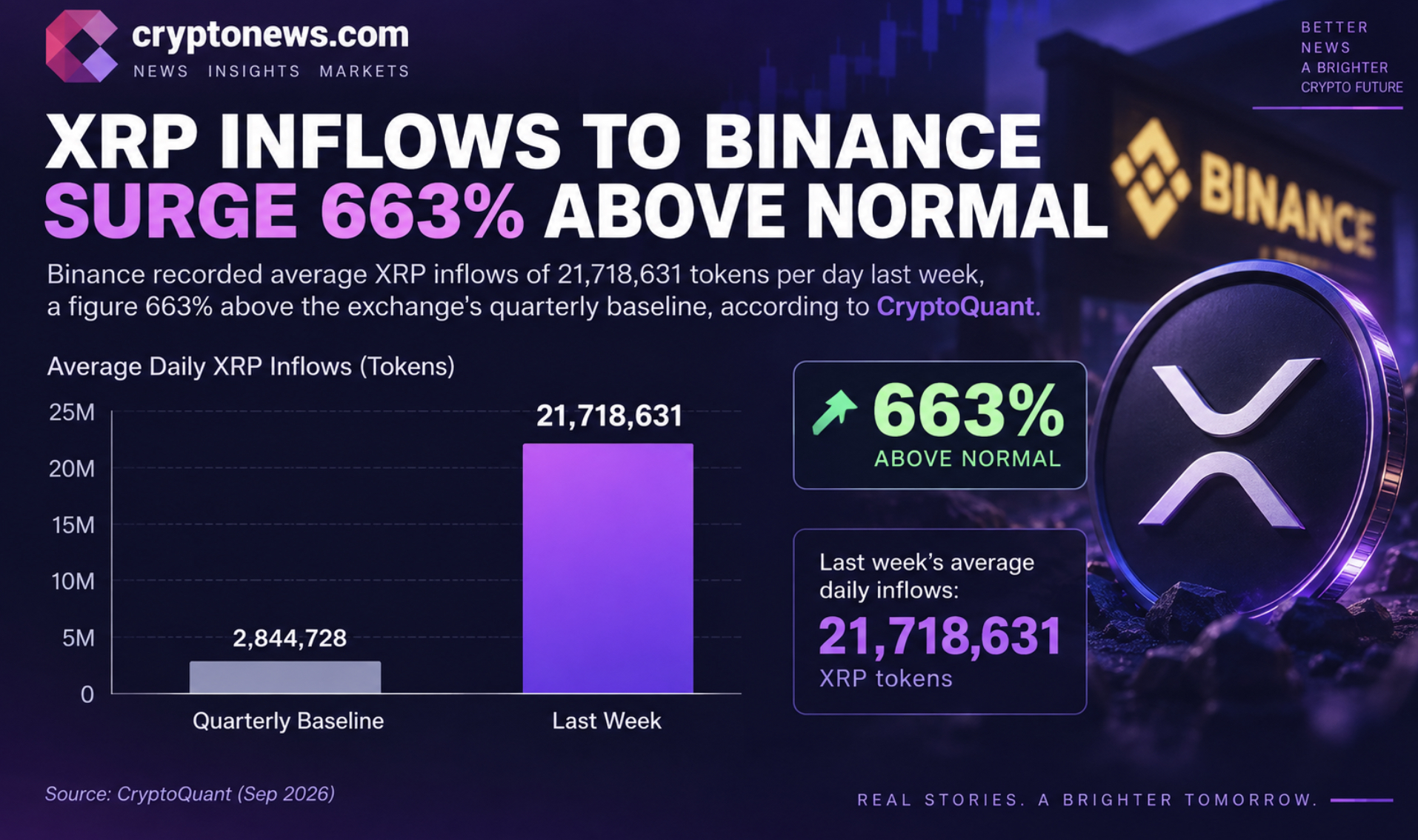

Binance recorded average XRP Exchange Churn Surges, Reserves Barely Move of 21,718,631 tokens per day last week, a figure 663% above the exchange’s quarterly baseline, according to CryptoQuant news data. The number looks alarming in isolation, but the real question is whether it reflects large holders preparing to sell or simply a market repositioning around two major catalysts in the same week.
The data do not confirm outright intent to sell. What they show is a sharp increase in gross exchange turnover concentrated in a handful of sessions rather than a steady, week-long buildup. This is a gap that matters for anyone trying to read whale behavior off a single headline figure.
Discover: The Best Token Presales
Why XRP Flows Spiked Around the CLARITY Vote and Fed Decision News?
Two regulatory and macro events bracket the inflow spikes on September 16 and 17. On September 15, the U.S. Senate failed to advance the CLARITY Act after a 49-50 procedural vote, leaving the bill’s push for formal regulatory definitions of digital assets, including XRP, stalled rather than dead.
The following day, the Federal Reserve raised its target rate by 25 basis points to 3.75%-4.00%, its first hike since 2023. XRP fell toward $1.27 during the FOMC news before recovering to close at $1.410 on September 19.

The timing lines up cleanly enough to be notable, but it does not establish causation. Traders and large holders may have moved XRP between wallets and exchanges to adjust positioning around the rate decision rather than to prepare an outright exit. This is a possibility that the underlying data leaves open without confirming.
Earn $50 and Enter $300K Prize Draw on EdgeX
What the Three-Session Concentration Says About Binance Activity
The 663% average obscures how lopsided the week actually was. XRP inflows reached 91.2 million tokens on September 11, 44.5 million on September 16, and 41.7 million on September 17, three sessions carrying nearly the entire weekly total. No inflows were recorded at all on September 12, 15, 18, or 19, and September 20 lacked price, open-interest, funding, or transaction data entirely.
This concentration fits a pattern flagged earlier in the month, when whale inflows to Binance over the prior 30 days reached roughly 1.6 billion XRP, the highest level since March. Large-wallet transfers had declined steadily from May through July before reversing higher in August and continuing into September.

But gross deposits only tell half the story. Monthly inflows rose 457% while outflows increased 167% over the same stretch, and Binance’s XRP reserve ended the week at 2,630,628,140 tokens – just 0.22% above the quarterly baseline and 0.34% higher week over week.
Average outflows ran at 11,565,238 tokens per day, roughly half the inflow rate but still substantial. When inflows and outflows both surge while net reserves barely move, that points to turnover and repositioning across the crypto market rather than a coordinated distribution event.
Discover: Best Crypto IPO this September
Leverage and Network Activity Add to the Risk Signal
Deposit addresses averaged 788 per day, 129% above the quarterly baseline, confirming that more distinct wallets were interacting with the exchange rather than a single large actor moving repeatedly. Underlying network usage told a different story: XRP’s NVT ratio fell 32.1%, and transaction count dropped 16.4%, meaning on-chain activity did not keep pace with the exchange-level churn.
Derivatives positioning leaned more aggressively. Open interest reached 477.1 million, up 9.4% from the quarterly level, and the estimated leverage ratio climbed to 0.181, a 9.1% quarterly increase. Funding settled at 0.004 after doubling week over week, pushing up the cost of holding long positions.
Liquidations hit both sides. Short liquidations averaged 2.34 million XRP per day, up 199% week over week, while long liquidations averaged 2.93 million XRP per day. This is evidence that neither directional bet held comfortably through the volatility spike.
Taken together, the picture is one of a market reshuffling positions under macro and regulatory pressure rather than one signaling a clean distribution phase. Exchange inflows spiked, outflows rose nearly as fast, and Binance’s net holdings barely shifted. This is the pattern that raises short-term volatility risk without settling the question of whether XRP whale activity is bearish, defensive, or simply tactical.
Trade XRP on Bybit and Get a Chance to Win Our $1,000 USDT Airdrop
The post XRP News: Exchange Churn Surges, Binance Reserves Barely Move appeared first on Cryptonews.
What This Actually Means for XRP Price Action
XRP itself has been strong through this stretch, pushing above the $1.50 resistance level and touching an intraday high near $1.59 a gain of more than 5% in 24 hours during the period covered by this data.
The fact that reserves stayed essentially flat despite the inflow surge suggests buyers have been actively absorbing the supply moving onto the exchange, rather than that supply sitting there waiting to be dumped. Some coverage has floated $1.80 as a next technical target if this buying pressure holds, though that remains dependent on continued flow dynamics rather than a confirmed trend.
The bottom line: elevated exchange churn like this raises short-term volatility risk leveraged positions on both sides, active liquidations, heavier funding costs without settling the underlying question of whether large XRP holders are being bearish, defensive, or simply tactical.
The data supports “market reshuffling under regulatory and macro pressure” more than it supports any single clean narrative.
FAQ
Does a spike in exchange inflows always mean holders are about to sell?
Not necessarily a deposit doesn’t automatically equal a sale. Transferred tokens can serve as collateral for derivatives, support market-making, or simply reflect portfolio repositioning between wallets and platforms.
Why did XRP exchange activity spike in mid-September?
The sharpest transfer activity occurred around September 16-17, shortly after the U.S. Senate failed to advance the CLARITY Act on September 15 a regulatory setback that likely triggered broad repositioning across the market.
What does it mean that Binance’s reserves barely moved despite the inflow surge?
It suggests that buying activity on the exchange largely absorbed the incoming supply as it arrived, rather than that supply accumulating and sitting available for a future sell-off.