

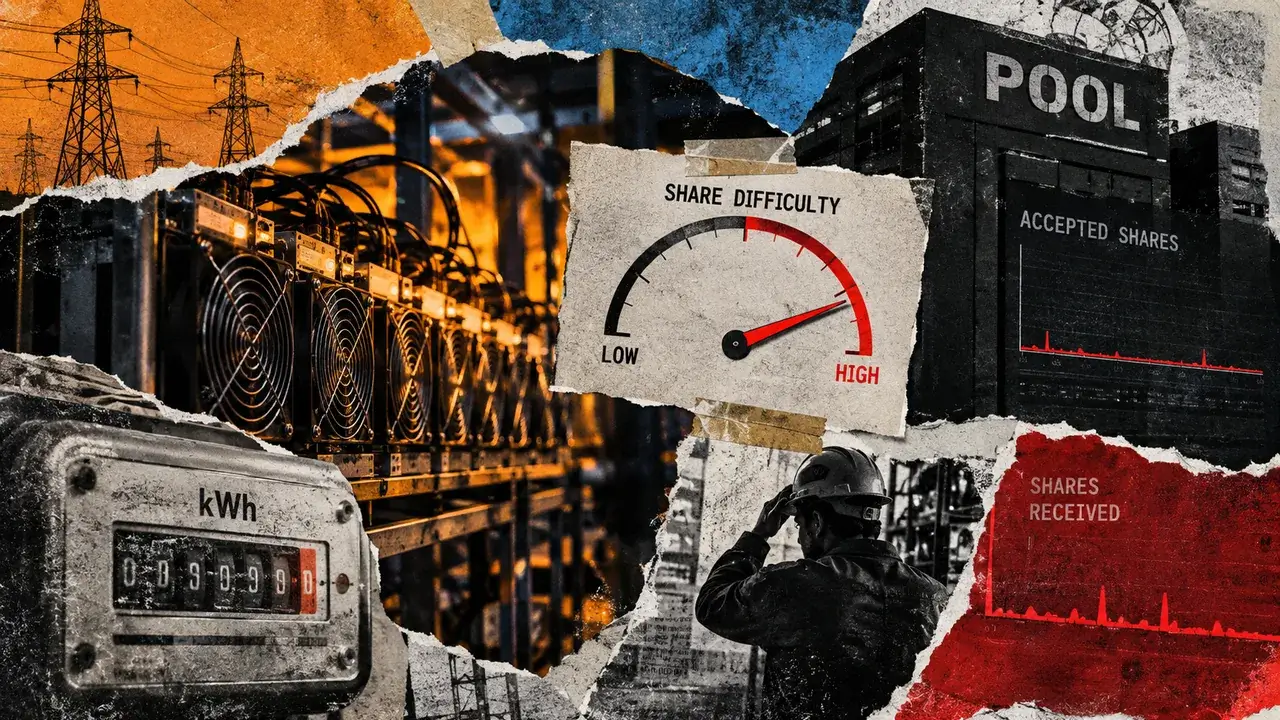

Some Bitcoin Mining Vardiff Can Strand Slowed Miners (variable difficulty) controllers can keep demanding work calibrated for a machine’s former speed after it cuts hashrate. The miner can keep hashing and consuming electricity while accepted shares become vanishingly rare.
Bitcoin Optech highlighted the failure mode on Sept. 18, drawing wider attention to an analysis that mining engineer Eric Price published in July. The finding concerns pool-assigned share difficulty, not Bitcoin’s network difficulty, and it describes a testable controller weakness rather than evidence of widespread miner losses.
How Bitcoin Mining Vardiff Can Strand Slowed Miners gets stuck
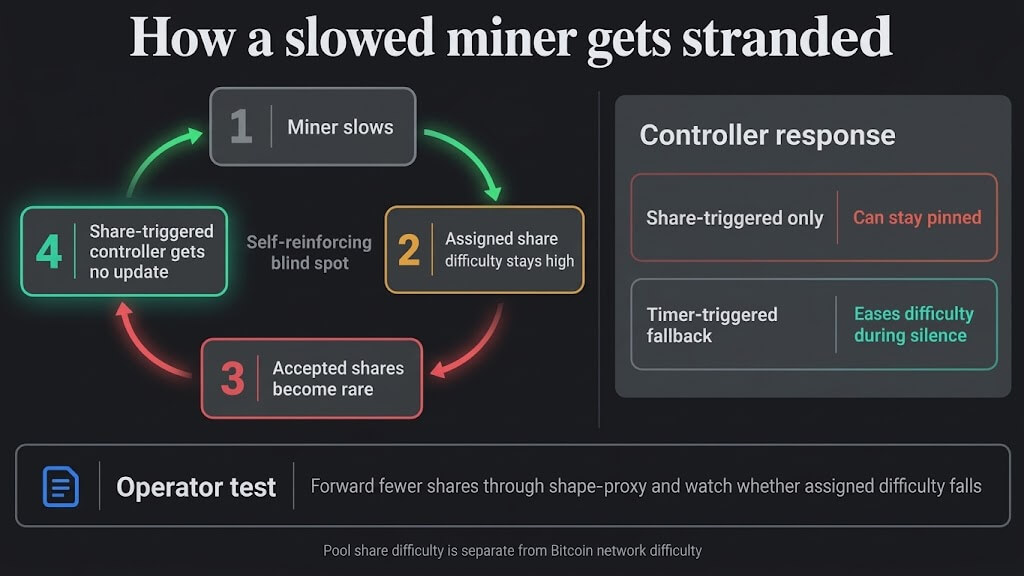
Pools assign each connection a share difficulty that is easier than Bitcoin’s block difficulty. A higher assigned difficulty corresponds to a harder share target. The submitted shares let the pool estimate hashrate and account for contributed work, while a variable-difficulty, or vardiff, controller adjusts the assignment to keep shares arriving at a useful rate.
Price’s controller analysis describes a trap after a miner slows sharply. If the controller recalculates only when a share arrives, the old, harder assignment makes the next share less likely. With no fresh share to trigger an update, the controller can hold the wrong difficulty, which keeps the share stream sparse.
Abrupt curtailment is operationally realistic. During a January 2026 U.S. winter storm, CryptoSlate reported a sharp network hashrate drop as miners reduced power use. The event was not linked to a vardiff loss.

The current Stratum V2 reference implementation avoids a permanent freeze by recalculating on a timer and lowering difficulty during a share drought. The analysis says recovery can still be slow on long-lived channels. That timer behavior belongs to the reference implementation, not to every deployment permitted by the Stratum V2 protocol.
The analysis and Optech identify ckpool as a deployed share-triggered example. How common the behavior is, and whether it has caused material real-world losses, has not been measured by the available sources.
A falling assigned difficulty shows that the tested controller has a recovery path. A target that stays pinned is evidence of slow or absent recovery under that profile and observation window, though timer cadence, channel age and random share arrival can affect the result.
Miners Can Now Test for This Themselves
One practical development coming out of this analysis: the MARA Foundation’s open-source “shape-proxy” tool lets operators test their own pool connection’s behavior directly. It works by acknowledging shares locally while forwarding only a controlled fraction upstream simulating step, ramp, and stall patterns that make the pool see an apparent hashrate decline without actually changing the miner’s physical output.
If the assigned difficulty falls in response, that’s evidence the tested controller has a working recovery path. If the target stays pinned regardless, that’s evidence of slow or absent recovery under that specific test profile though the analysis is careful to note that timer cadence, how long the channel has been open, and normal random variation in share arrival timing can all affect the result.
The Honest Caveat Here
This is a technical vulnerability analysis, not a confirmed report of widespread losses. As Digital Today’s coverage put it directly the analysis presented potential weaknesses and verification methods, but did not prove large-scale losses across the mining industry, and how widely the affected controller behavior is actually deployed or whether it has caused meaningful financial losses in practice can’t be confirmed from currently available public information.
FAQs
What is a vardiff controller in Bitcoin mining?
A variable difficulty (vardiff) controller is software, run by a mining pool or a proxy between miner and pool, that continuously adjusts the difficulty target assigned to a specific miner connection, based on how quickly that miner is submitting valid shares.
How can a vardiff controller strand a slowed miner?
If a controller only recalculates difficulty upon receiving a new share, a miner that slows down sharply may struggle to submit shares often enough to trigger that recalculation leaving it stuck with a difficulty target calibrated for its former, faster speed.
Has this vardiff issue caused confirmed financial losses for miners?
Not confirmed the analysis identified a real technical failure mode and a way to test for it, but current public information doesn’t establish how widely it’s actually deployed or whether it has caused meaningful losses at scale.



